When tackling standardized tests like the SAT, ACT, or other multiple-choice exams, having a toolbox of efficient problem-solving strategies can make all the difference. Two of the most versatile strategies to simplify problem-solving are Picking Numbers and Plugging in the Answers. These techniques are lifesavers, especially when algebra gets messy or when you're short on time. Let’s dive into how and when to use them effectively.

Picking Numbers
This strategy is perfect for questions with variables in the answer choices or when the problem seems abstract. By substituting specific values for the variables, you can turn messy algebra into manageable arithmetic.
How to Pick Numbers:
- Choose an easy number: Pick a simple, manageable value for the variable(s). Avoid 0 or 1 unless the problem specifically allows it, as these numbers can sometimes give misleading results. Make sure your number follows the “rules” of the questions (i.e., if a question says a number is odd, pick an odd number, etc.).
- Solve using your chosen number: Work through the problem using your substituted value.
- Test each answer choice: Replace the variable in each option with your chosen number and see which one matches your calculated result.
Let’s see this strategy in action with a high-difficulty SAT Advanced Math question about Nonlinear Functions.
Example:
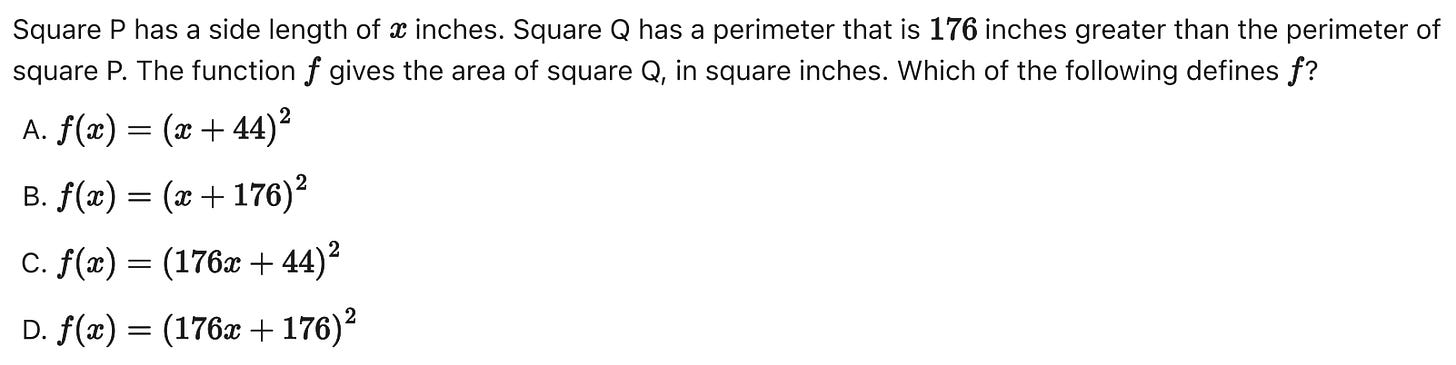
Notice that we have x in both the question itself and in the answer choices. That means we can pick our own number for x. Don’t worry about the number being “realistic.”
Let’s say x = 2. That means that Square P has a side length of 2 inches and a perimeter of 8 inches (4 ✕ 2). Square Q has a perimeter than is 176 inches greater than the perimeter of square P, so square Q has a perimeter of 176 + 8 = 184 inches.
We are asked for the area of square Q, so first we need to find the side length by dividing the perimeter by 4: 184 ÷ 4 = 46. Each side is 46, so the area is 462. Notice that’s all we need to do here. We don’t actually need to calculate 462 because the answer choices are all squares.
When we plug 2 in for x in the answer choices we get:
A. f(x) = (2 + 44)2
A is likely our answer because 2 + 44 = 46, we always want to test all four answer choices when we use this strategy. If we end up with two answers that work, we need to pick another number.
B. f(x) = (2 + 176)2
C. f(x) = (176 ✕ 2 + 44)2
D. f(x) = (176 ✕ 2 + 176)2
Even after quickly evaluating the three remaining answer choices, it’s clear that A is the correct one.
Plugging in the Answers
This strategy is ideal for multiple-choice questions when the answers represent possible solutions to the problem. Instead of solving the problem algebraically, you test each answer option directly to see which one works.
How to Plug in the Answers:
- Start with the middle answer choice: Most multiple-choice questions present the options in ascending or descending order. Beginning with the middle choice (or one of the middle choices if there are only four options like on the SAT) allows you to eliminate half of the options right away, depending on whether the tested answer is too high or too low.
- Work through the problem: Use the answer choice to work backwards through the question and confirm your numbers match the ones that are provided.
- Eliminate and refine: If the middle choice doesn’t work, use logic to decide whether you should test a larger or smaller number.
Note: Multiple-choice questions on the SAT Math section have four answer choices. There are five answer choices each on the current version of the ACT Math section but the Enhanced ACT Math section, which will debut digitally in April 2025 and on paper in September 2025, will have questions with only four choices each.
There are two scenarios when plugging in the answers can be helpful: on Algebra questions that ask you to solve for a single variable and on complicated word problems that require you to set up complicated algebraic equations. Let’s look at an example of each.
Example 1 (Algebra):
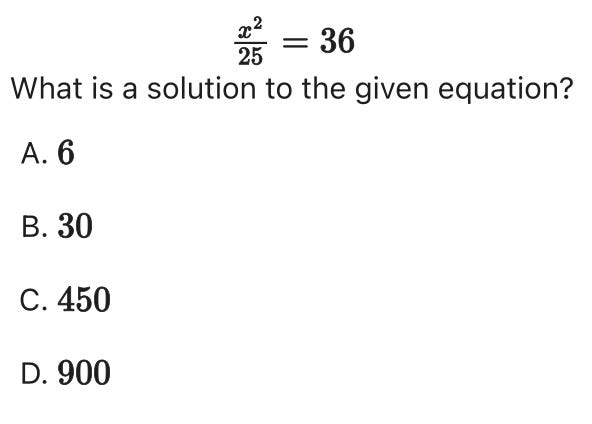
While you could absolutely solve this question algebraically or, for the SAT, plug it into Desmos, it’s a great candidate for plugging in the answers. You’re asked for a solution to the given equation, which is just a more complicated way of asking you to solve for x. Start with B or C.
Let’s start with B because 30 is an easier number to deal with than 450.
B works, and we’re done with this question. When you Plug in the Answers, you don’t have to test every answer choice. Once you find the one that works, you can move on.
Example 2 (Word Problem):
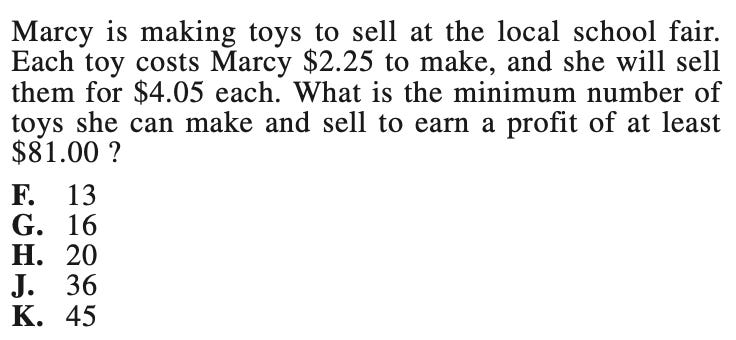
This ACT question would involve setting up an inequality if you wanted to solve it algebraically. It’s much easier to plug in the answers! But there’s one catch. Because the question is asking us to find the minimum number of toys, we’re going to start with the smallest answer choice instead of the middle one.
Let’s work through the problem using F, 13. Remember: the answer choices represent the number of toys, so keep that in mind when you start doing calculations.
If Marcy makes and sells 13 toys, she spends $29.25 making them ($2.25 ✕ 13) and sells them for $52.65 ($4.05 ✕ 13). That’s a profit of $23.40 ($52.65 – $29.25).
That’s way too low, so eliminate F.
If you want to be even smarter about this, realize that the amount she sells them for (aka the revenue) is lower than the profit we’re looking for, so we don’t even have to find the difference.
Instead of going straight to G, which is only 3 higher than F, let’s go to H. If it’s too high, we know that G is our answer.
If Marcy makes and sells 20 toys, she spends $45 making them ($2.25 ✕ 20) and sells them for $81 ($4.05 ✕ 20). That’s a profit of $23.40 ($52.65 – $29.25).
That’s way too low, so eliminate F.
Here, the revenue equals the profit we’re looking for, so be careful. You may see “81” and think we’ve found the answer, but we want the revenue minus the cost (which is how we find profit) to be 81.
At this point, we’ve eliminated 3 of the 5 choices!
Move onto J:
If Marcy makes and sells 36 toys, she spends $81 making them ($2.25 ✕ 36) and sells them for $145.80 ($4.05 ✕ 36). Again, you may see that 81 and think we have our answer, but that’s the cost, not the profit. The profit is $64.80 ($145.80 - $81.00), which is still lower than our target, so the answer must be K.
On the ACT, you should absolutely choose K and move on without checking it because of the time crunch on the Math section. But for fun, let’s double check that K, 45, is correct:
If Marcy makes and sells 45 toys, she spends $101.25 making them ($2.25 ✕ 45) and sells them for $182.25 ($4.05 ✕ 45). $182.25 – $101.25 is $81, which matches the question.
When to Use These Strategies
Use Picking Numbers when the answer choices contain variables that are also featured in the question.
Use Plugging in the Answers when the answer choices are numbers and you’re either asked for a specific value or given a word problem.
Why These Strategies Work
Both techniques leverage the structure of standardized tests, where the correct answer is always among the given options. By focusing on elimination and substitution rather than formal algebraic solutions, you can save time and minimize errors.
Final Tips
- Practice these strategies on real test questions to build your confidence.
- Combine them with other techniques, like estimation and logical reasoning, for even greater efficiency.
- Remember: Standardized tests reward flexibility and efficiency. If one approach isn’t working, switch to another!
By mastering Picking Numbers and Plugging in the Answers, you’ll simplify even the trickiest math questions on standardized tests. These strategies are game-changers, especially under the time pressure of exams like the SAT and ACT, where every second counts. Practicing these approaches can help you work smarter, not harder, and make the most of your test day.
If you found these tips helpful, make sure to subscribe for more actionable test strategies and insights straight to your inbox! Have a tricky math question or want tailored advice for your test prep journey? Drop a comment or reach out. I’d love to hear from you! Happy solving!
This piece first appeared on our Substack. Read it there or subscribe to get new essays on testing, admissions, and learning in your inbox.