Last week, New York Magazine ran an essay by a member of the Horace Mann class of 1997, revisiting the Times article that had dubbed his graduating class “the class of mediocrity.” The author, Jamie Mandell, spent a few years tracking down classmates and asking them whether, by middle age, the school had paid off.
One line stuck. Describing his early post-college years, Mandell catalogs the jobs he took that felt “embarrassing for someone with my privileged background,” including copyediting a yoga magazine, headhunting hospice nurses, and, this is the one I want to talk about, tutoring distracted teenagers.
The job on his embarrassment list built my career. I graduated from Horace Mann in 2006.
I have been in this position before. There were two instances in the almost twenty years since graduating when I’ve run into Horace Mann classmates, asked what they’re up to, and watched their faces reorganize when I told them what I do.
“Oh,” one said. “I tutored for Kaplan in college.”
The other: “A friend of mine did that as a side hustle.”
Both were trying, I think, to be friendly. To find the handhold of common ground. The problem is the handhold they reached for was the one where tutoring is a thing college kids do for beer money, not a profession that an adult can spend her career building. It’s a polite dismissal dressed up as relatability, and anyone who works in this industry has absorbed a version of it.
Mandell isn’t doing it on purpose. His list is a list of jobs that felt embarrassing to a twenty-five-year-old with a Horace Mann diploma, and I have sympathy for that twenty-five-year-old. In many ways, I was that twenty-five-year-old. The premise of his essay is that Horace Mann instilled in him a set of expectations he spent the next thirty years trying to metabolize. I’d quarrel with that premise. The expectations came from the families the school serves, not the school itself, though I’ll grant that in 1997, faculty and administration may have been in the mix too. The piece he’s revisiting reports that 44% of his class got into the Ivy League and quotes a valedictorian who felt he’d failed because he went to Penn instead of Dartmouth. Some of that was likely coming from inside the building too.
But the college admissions landscape has changed so dramatically in thirty years that whatever standard the school was enforcing in 1997 couldn’t possibly hold now. For my class in 2006, closer to a third went to the Ivy League. Today the number is smaller still. Of course tutoring landed on the 1997 list. At Horace Mann then, the families (and maybe the adults in the building) said that tutoring was what you did on your way to becoming something else.
I’ve crossed paths with Horace Mann people for twenty years (former teachers, faculty I didn’t know when I was a student, current administrators) partly by accident, because I work in education in New York and the worlds overlap. Not one of them has ever made me feel like I was a disappointment to the Horace Mann culture or ethos. Not one.
The assumption, though, doesn’t survive contact with my life.
Private tutoring is a serious industry. Technavio projects the US market will grow by $28.85 billion between 2025 and 2029. There are firms with full-time staff, clinical directors, curriculum teams, and referral relationships with every major private school in the five boroughs. It’s a profession in the same sense that a boutique law practice or a dental group is.
It’s also, I’ll grant, a profession that started, for me, as a side hustle.
The Kaplan center was across the street from my NYU dorm. I was an undergrad, I did the math on barista wages versus what Kaplan was paying per session, and I walked in. That part of the origin story is exactly the one my Upper East Side classmates were pattern-matching against.
What they didn’t know, because the pattern doesn’t account for it, is that some of us stayed, and got good, and decided with our eyes open that we’d rather build a business than grind through a structure somebody else designed.
I set my own hours and choose my own students. The problems I work on are ones I actually find interesting: how teenagers learn, where they get stuck, what it takes to move a score from a 1350 to a 1520 without breaking the kid. I have a three-year-old and a seventeen-month-old, and my calendar has room in it for them. That’s the whole thing, really.
The NYMag piece quotes a classmate describing this class of people as having “a need to be our own bosses.” He means it as a diagnosis. I’ll take it as a compliment.
This isn’t the piece where Horace Mann was a waste. It wasn’t. What I got there was, by any reasonable measure, a college education by age eighteen.
I was a theater kid. In eighth grade we did Once Upon a Mattress. The set was a literal playground with a working slide, the costumes were gorgeous. Freshman year, the main theater was under construction, so the school built us an outdoor stage in the shape of a pirate ship to mount The Pirates of Penzance. Sophomore spring break I went to London and Oxford with the theater department: we saw Judi Dench in A Winter’s Tale and a production of Moira Buffini’s Dinner, which remains one of my favorite plays. Senior year I went to Edinburgh. The Shakespeare I know, I know because I was in it, in an acting seminar junior year that assumed sixteen-year-olds could handle the text.

I took contemporary art history, and on a family trip to Paris I did an extra credit assignment because I wanted to. The Whitney Biennial was homework: pick a piece in the show and compare it to something from the syllabus. I compared an Elizabeth Peyton self-portrait to Ingres’s Odalisque, and I still remember parts of the argument I made. I’m still using what I learned in museums. I did an elective senior independent study on psychoanalysis and art, which produced a deeply ill-advised one-act based on Freud’s case study of Leonardo. I was not, to put it mildly, a fun sixteen-year-old.
I wrote for the school paper, The Record. One week my assignment was a piece on middle school girls emulating the behavior in the Gossip Girl books. This was 2004, before the show existed. I found author Cecily von Ziegesar’s phone number in the actual white pages and called her, and she gave me an interview. I was fifteen. The reason I thought to do that, and the reason I thought it would work, is that Horace Mann had told me, in a thousand small ways, that intelligence was good and curiosity was a commodity and a reasonable fifteen-year-old with a legal pad could ask an adult novelist for her time. That is not a small thing to have been taught.
None of this trained me out of the job I eventually took. It trained me into it. The curiosity is how I do the work, how I figure out why a kid is missing geometry questions or losing twenty minutes every test on reading comprehension. The confidence to call a stranger with a legal pad is the same confidence it takes to start a business and keep one running. When a family sits down to talk to me about their seventeen-year-old, what they’re paying for is the fluency Horace Mann gave me, whether they’d call it that or not.
Here’s the complication.
I know a lot of tutors in this city and in other cities who’ve been treated as the help. Asked to use the service entrance. Handed a coat on the way in. Ghosted on invoices by families with multiple homes.
It has never happened to me.
I don’t think that’s because I’m better at my job than they are. Some of them are extraordinary, and I’ve hired a few. I think it’s because I went to Horace Mann and stayed in New York, and that combination reads, in the world my clients move in, as shorthand for one of us. I grew up in the same apartment buildings. I went to the same schools. I know what the uniform policy is at Spence and where the good coffee is on 86th. That social positioning does real work in how I’m treated, and it would be dishonest to pretend it doesn’t.
So when Jamie Mandell, or anyone really, asks whether his Horace Mann education paid off, I can answer in part for mine. The social fluency the school gave me is a real return on the investment my parents made. It isn’t the one the tuition brochure was selling, but it’s the one my business runs on.
The evidence of all this is fresh. Last Thursday, the school invited me back onto campus to lead a workshop for Book Day, the event where the entire Upper School reads one book together and spends a day on it. (It used to be annual; it’s every other year now.) This year’s book was Beyond Measure: The Hidden History of Measurement by James Vincent, and I was there to teach the history of standardized testing, which is, professionally, a thing I have opinions about.
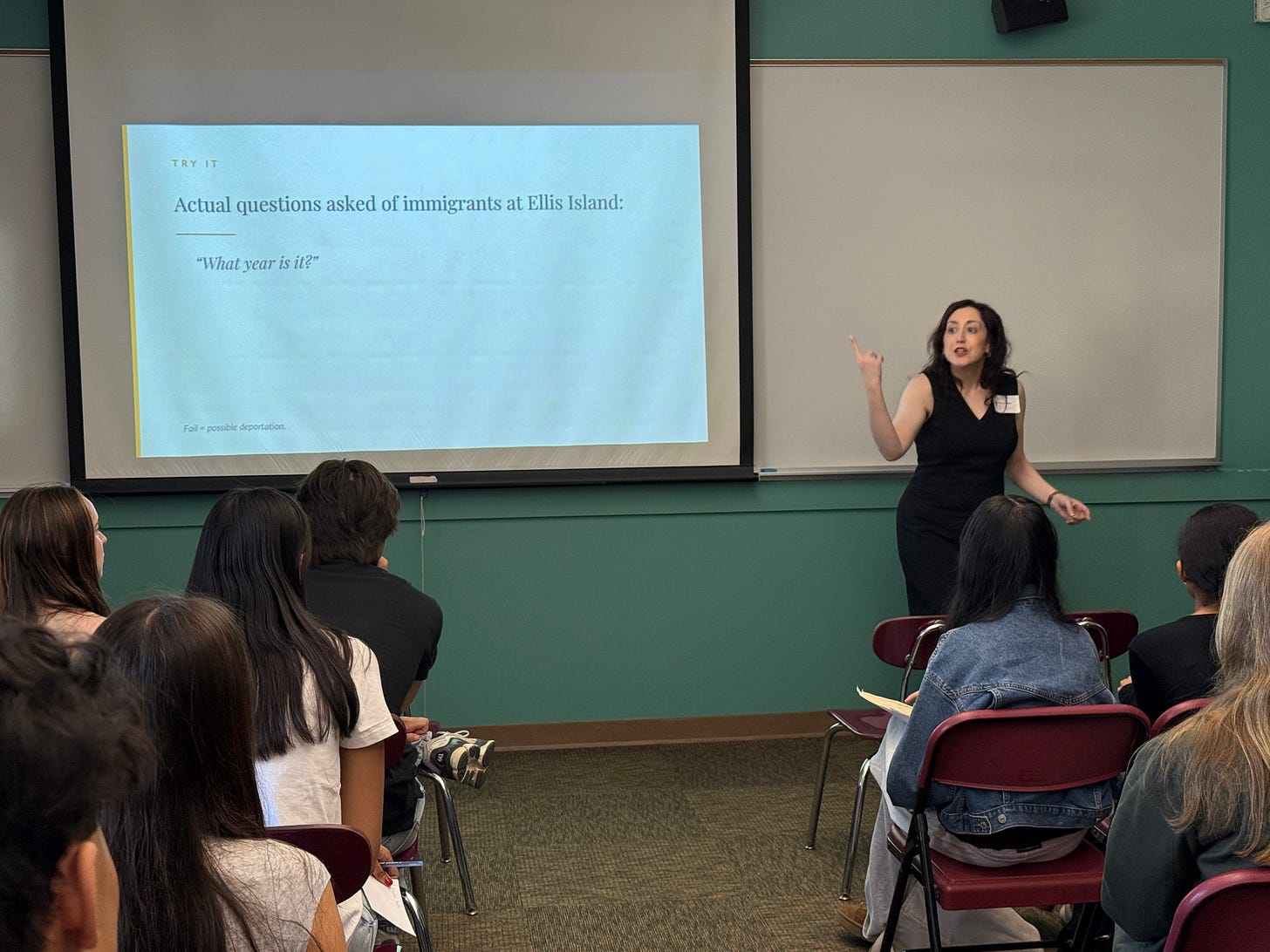
The kids were engaged and present. They questioned the status quo, and not because an adult was in the room. They were actually curious where the assumptions came from and did not shy away from uncomfortable conversations about how their own academic or, for some of them, socioeconomic privilege complicates a changing college admissions and standardized testing landscape.
After my own workshop ended, I slipped into the back of a session led by my favorite English teacher, the woman who taught me in high school and now runs the Upper School. She was leading a discussion of A Room of One’s Own in the very classroom I first read it in, where the language rearranged something I didn’t have a name for at the time, where I learned how to love a sentence. I watched a classroom full of teenagers talk about objective and subjective time and Virginia Woolf and then tried to follow along as a senior connected it all to Physics and concepts of space and time that, frankly, went way above my head. I sat in the back and thought: these kids know exactly how lucky they are to be at this school.
I don’t think that was the, as they’d say, vibe when I was there twenty years ago. I’m not sure it was the vibe when the Mandell graduated in 1997. The rigor was always there. The awareness is newer.
I’ve been back to campus before, but not like this. Not in a room where the students were doing the thing the school is actually for.

Reading Mandell’s list of embarrassments (yoga magazine, hospice nurses, distracted teenagers), I didn’t bristle. I recognized the twenty-five-year-old the list was describing, and I felt the particular grief of knowing whatever you ended up doing was going to be measured against a standard nobody ever named out loud.
What I’d say to him, and to his classmate who went into private equity, and to the ones who stopped working or moved to Sweden or are still wondering at 46 whether they measured up, is something like this.
The job you put on your list of embarrassments pays my mortgage and built the life I’m actually living. I didn’t stumble into it on the way to something else. I keep choosing it, I’m good at it, and last week the school invited me back to teach the kids about it.
Maybe that’s the return you were looking for. It was hiding in one of the jobs you dismissed.
This piece first appeared on our Substack. Read it there or subscribe to get new essays on testing, admissions, and learning in your inbox.