My friend Julia Lynch sent me a Peter Diamandis tweet today that’s been making the rounds:
I work with high schoolers every day. I’m on Zoom with them while they problem-solve, struggle, and figure things out. So when I see takes like this, I’m not thinking about them abstractly. I think about the actual students in front of me.
He’s half right. But the half he’s wrong about matters a lot.
Where He’s Right
The world these kids are entering looks nothing like the one their parents graduated into. I don’t think that’s controversial to say at this point.
AI is changing what “entry-level” means. Tasks that used to take a junior employee a week can now be done in an afternoon. The kids I work with are already using AI tools daily, and the ones who know how to use them well (who can evaluate output, ask better questions, iterate) have a real advantage. Schools that pretend this isn’t happening are behind.
And the entrepreneurial mindset piece? I actually agree with the spirit of it. The students I see do well long-term are the ones who can identify a problem, figure out an approach, and execute. Not the ones who wait to be told exactly what to do.
The Part That Doesn’t Hold Up
Here’s the thing. “AI-first” is not a curriculum. It’s a slogan.
What does “AI-first” actually look like in a 10th grade English class? In AP Chemistry? In a school that can barely fund its existing programs? Diamandis doesn’t say because that’s the hard part. The vision is easy. Implementation is where everyone gets stuck.
And the entrepreneur vs. employee framing? It sounds great on Twitter and falls apart in a classroom.
Most 16-year-olds don’t need to be told to “think like entrepreneurs.” They need to learn how to read carefully, write clearly, and reason through a problem. Those skills are the foundation for everything else, including entrepreneurship.
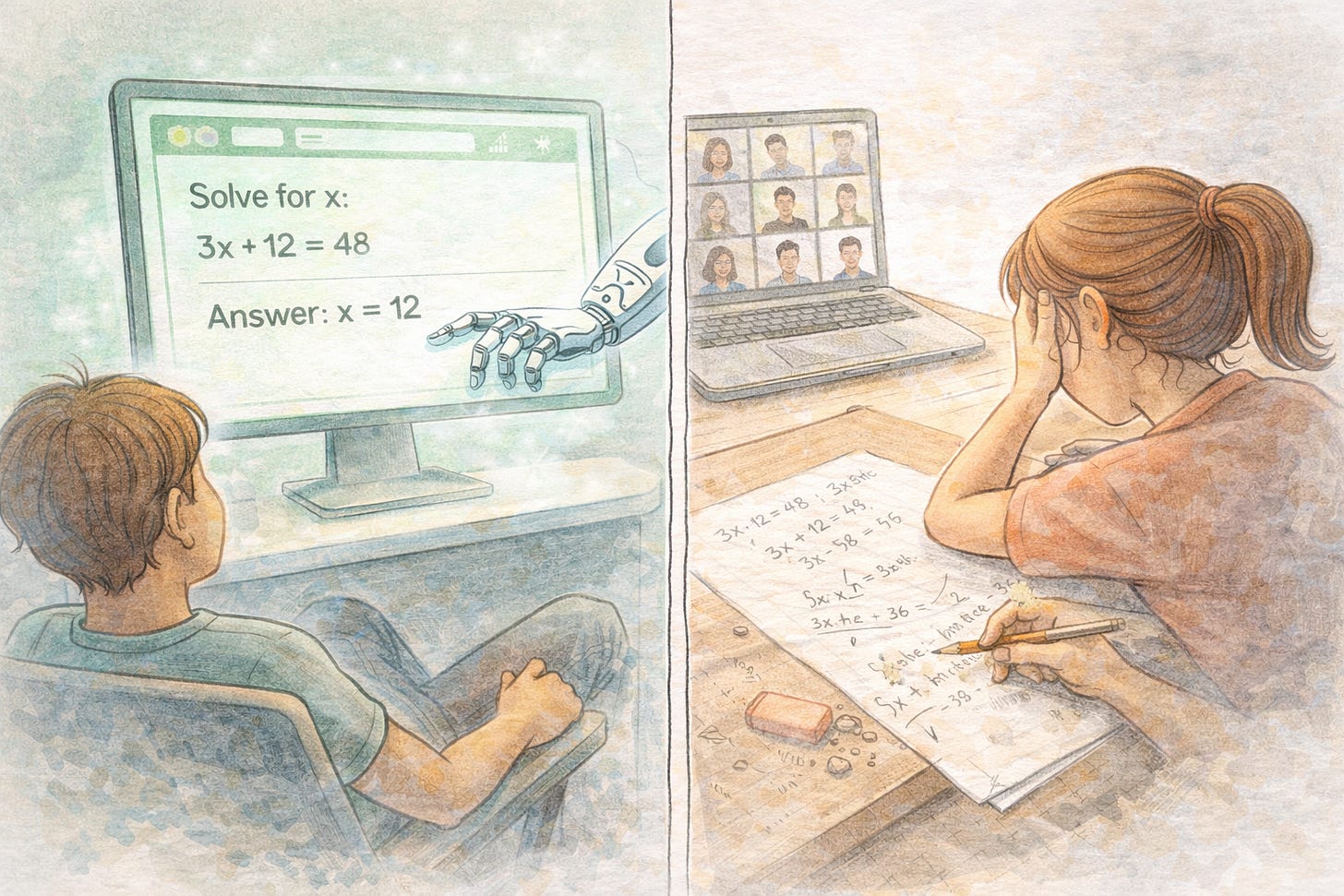
I’ve seen students try to use AI to shortcut their way through practice problems. They get a plausible-looking answer, accept it, and move on. They don’t learn anything. This isn’t just my anecdotal experience: a Wharton study found that students with unrestricted AI access gained only 30% performance improvement, compared to 64% for students whose AI help was controlled. Even the motivated, high-performing students over-relied on it. They knew it was hurting their learning and did it anyway.
The students I see actually get better? They use AI as a tool, not a replacement for thinking. And that distinction doesn’t come from an “AI-first curriculum.” It comes from someone teaching them how to think in the first place.
The Alpha School Question
If you want to see what “AI-first” looks like when someone actually builds it, look at Alpha School, the private school model Diamandis has been championing on his podcast. The pitch: students finish core academics in 2 hours a day using adaptive software, then spend the rest of their time on life skills and projects. Traditional teachers are replaced by “guides.” The marketing says kids hit top 1% test scores.
I’m genuinely curious about it. But there are real questions about whether it delivers what it promises.
The results are mostly self-reported. When a related charter application landed in Pennsylvania, the Department of Education rejected it, calling the AI instructional model “untested.” And some parents have reported that their kids fell behind without anyone flagging it: dashboards showed progress while grade-level gaps grew underneath.
That last part is what gets me. Software can tell you a student completed something. It can’t tell you whether they actually understood it. I see this all the time: a student “finishes” a module, checks the box, moves on, and three weeks later can’t apply the concept on a practice test. Completion and comprehension are not the same thing, and figuring out the difference requires a human who knows the student.
A Harvard survey of 7,000 high school students found that nearly half admitted to over-relying on AI for learning, and over 40% said they’d tried to cut back but couldn’t. The same study found that students rate math and English as less important since AI came along. That should worry anyone in education, regardless of where they fall on the AI-in-schools debate.
Replacing that human with a “guide” and a dashboard is a bold bet. Maybe it works for some kids. But it’s one experiment, not a proven model.
What I’d actually tell school administrators
If I had five minutes with a high school administrator, I wouldn’t say “go AI-first.” I’d say:
Teach kids to evaluate, not just consume. Whether it’s AI output, a news article, or a data set…can they tell good information from garbage? That skill was important before AI; it’s way more important now.
Stop treating AI as its own subject. It’s a tool that cuts across everything. Integrate it that way.
Protect the fundamentals. Reading comprehension, quantitative reasoning, clear writing. These aren’t obsolete. They’re what make someone good at using AI instead of just dependent on it.
Give students real problems to solve. Not hypothetical case studies, but actual problems with ambiguity and constraints. That builds the resourcefulness Diamandis is talking about without the jargon.
And please, stop panic-pivoting based on tweets. The worst thing a school can do right now is lurch from trend to trend. Students need consistency, not a new initiative every semester.
The Real Social Contract
Diamandis says the social contract is vaporizing. And sure, the old playbook of get-good-grades-go-to-college-get-a-stable-job is fraying.
But the social contract isn’t just about employment. It’s about what we owe kids while they’re still growing up. And what we owe them is a strong enough foundation that they can handle whatever comes, whether that’s an AI-driven economy or something none of us have thought of yet.
The kids who will be fine in an AI-driven world aren’t the ones who learned to code at 14 or started a dropshipping business in high school. They’re the ones who learned how to learn. That’s less tweetable, but it’s what I keep seeing play out with the students I actually work with.
This piece first appeared on our Substack. Read it there or subscribe to get new essays on testing, admissions, and learning in your inbox.