A piece in this morning’s Times covers Chinese families outsourcing homework supervision to AI chatbots. If you work with teenagers, none of this is news. AI already outlines their essays, checks their algebra, summarizes their readings, makes flashcards. Sometimes it just does the thinking for them.
The interesting question isn’t whether students are using AI. It’s whether anyone is helping them get skeptical about it.
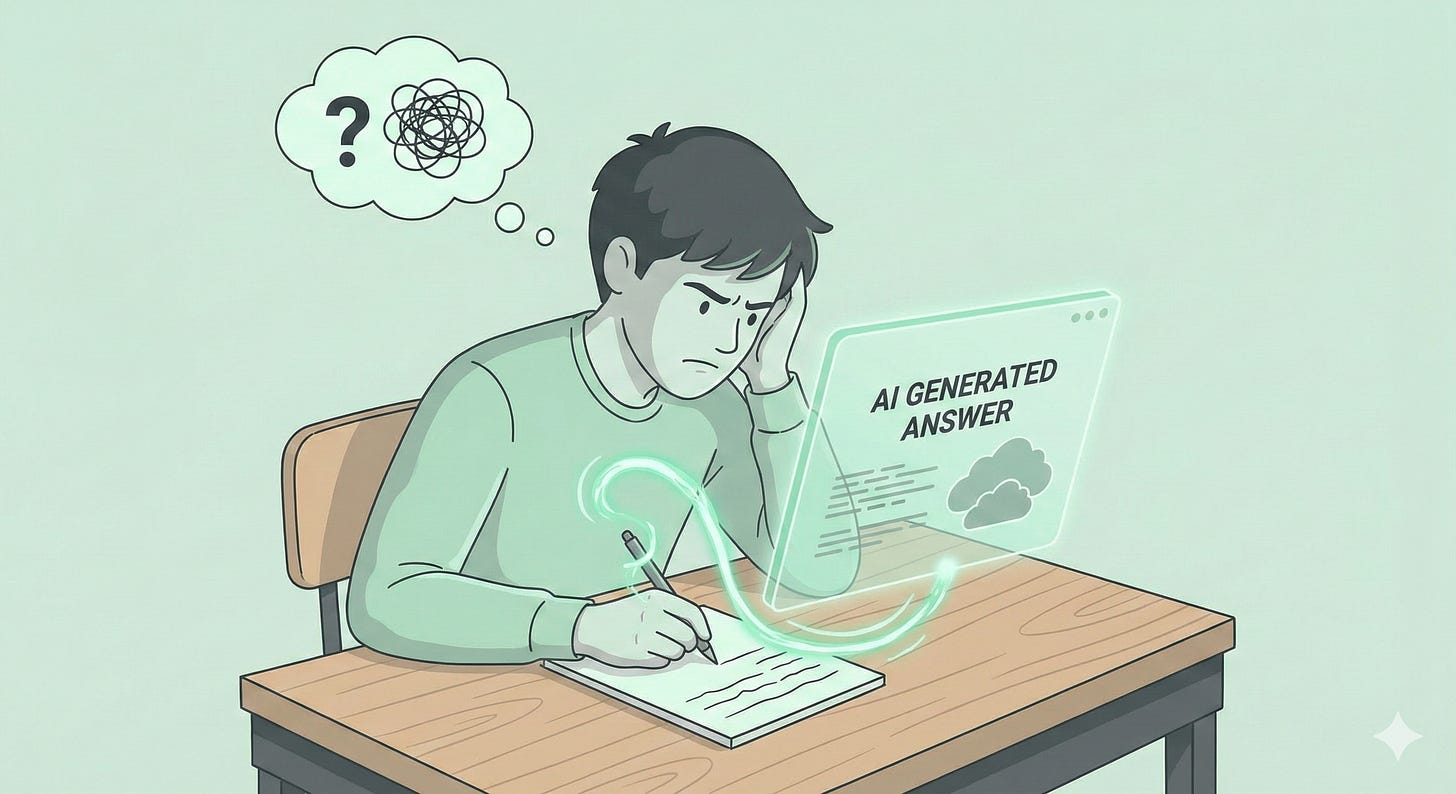
We keep treating this as a cheating problem, and I think that’s the wrong frame. The real issue is subtler and harder to see. A student asks AI to explain a concept before trying it or accepts the answer without questioning it or reads the summary instead of the chapter. None of that looks like cheating. A teacher would never flag it, a parent would never notice it. But do it enough and you gradually lose the ability to sit with a hard problem. You stop tolerating confusion. You stop wrestling with the material. And the wrestling is where the actual learning happens, as much as students hate hearing that.
Nobody’s found a shortcut around this. Not yet, anyway.
The SAT Problem
Google recently partnered with Princeton Review to let students generate SAT practice tests inside Gemini. Free, on-demand, full-length. Sounds great on the surface.
Here’s the problem. The digital SAT’s Reading and Writing section has a specific structure that matters for prep. Vocabulary-in-context questions come first in each module. Rhetorical synthesis appears last. Difficulty ramps in a calibrated way. The second module adapts based on how you performed in the first. Students who prep seriously learn this structure and build their pacing around it. Knowing what’s coming and when is actually part of the skill.
When I looked at what Gemini actually produces, the first Reading & Writing question wasn’t consistently vocabulary-in-context. The sequencing was off.
That sounds like a small thing. It’s not. Students budget their focus based on where they expect certain question types. When the structure shifts, they’re not really practicing for the SAT anymore. They’re practicing for something that looks like the SAT but trains the wrong reflexes. And wrong reflexes might actually be worse than no practice, because you don’t realize the problem until you’re sitting in the testing center wondering why nothing feels right.
AI generates plausible-looking material quickly. It doesn’t guarantee any of it is correctly structured. For standardized tests, structure is half the skill.
What Evaluation Actually Looks Like Now
This goes beyond test prep. AI can draft essays, generate explanations, build practice sets, summarize chapters. What it can’t do is notice when it’s slightly wrong in a way that sounds completely right. It doesn’t feel uncertain. It doesn’t catch its own drift.
That’s what humans are actually for in this ever-changing landscape. And I keep coming back to the fact that it’s basically a humanities job, which is funny given how many years people spent dismissing those degrees. Business Insider recently ran a piece on employers rediscovering the value of English majors in an AI world. Literature, philosophy, history, and rhetoric train you to spot weak arguments, weigh evidence, and sit with ambiguity. What used to be a hard sell at career fairs is now what separates someone who can actually use AI from someone who just accepts whatever it says, confident that a fluent answer must be a correct one.
The students I’m least worried about aren’t the ones who use AI the most. They’re the ones who try the problem first, check the output after, and occasionally tell the chatbot it got something wrong.
For Families
If you’re raising a teenager, banning AI isn’t realistic. Letting them use it uncritically isn’t great either. Most families I work with are somewhere in the middle and still figuring it out, which, for what it’s worth, seems right to me.
What I tell them: AI should come after effort, not before. Your kid attempts the math problem or reads the chapter. Then they can use AI to clarify a specific thing they’re stuck on. If they’re reaching for ChatGPT before they’ve picked up a pencil, that’s the habit to work on, and it’s a harder habit to unlearn the longer it goes on.
The quality of the question matters too. “Explain this” is a very different request from “I tried solving this with substitution and got 12. Where did my reasoning break down?” The first outsources thinking while the second sharpens it. Get your kid to paste in their own work, not just the problem.
After they’ve used AI, check: can they solve a similar problem on their own? Can they explain why the answer makes sense? If they can’t, they didn’t really learn anything. Getting an answer isn’t the same as being able to replicate it on their own.
For test prep specifically, AI-generated practice questions are fine for reviewing concepts, but don’t use them as a substitute for official materials when the test has a specific structure. The sequencing matters, and AI doesn’t reliably get it right, even when it’s being fed vetted content.
And if your kid has never pushed back on a ChatGPT explanation, that’s worth a conversation. The confidence that actually matters in academic work comes from learning to say “I don’t think that’s right,” not from having answers delivered.
This piece first appeared on our Substack. Read it there or subscribe to get new essays on testing, admissions, and learning in your inbox.