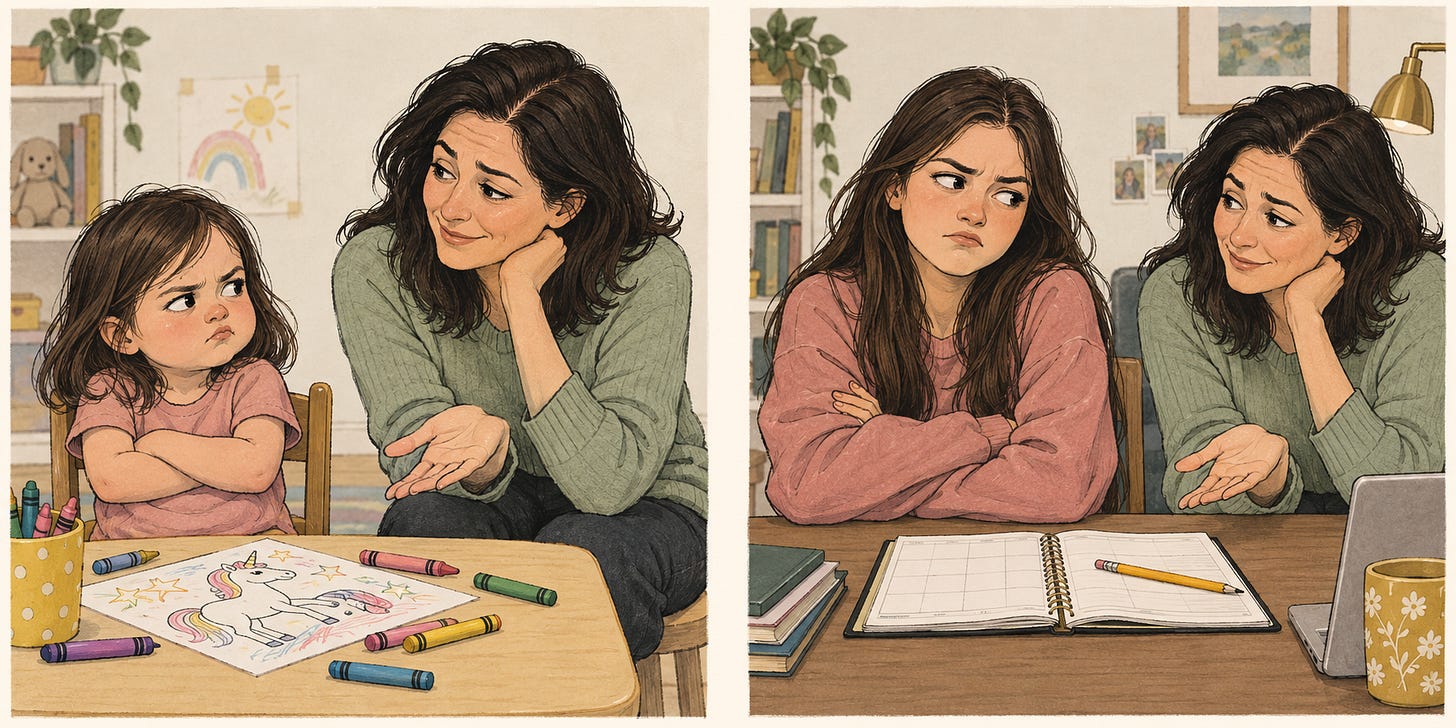
I started working with teenagers eight months after my own adolescence ended. I’ve jokingly referred to myself as a “professional teenologist,” which largely involves getting a teenager to do something their parents have already asked them to do anywhere from five to five hundred times. When baffled parents ask me how I manage to get their teen to use a homework planner or finally email their teacher about a make-up quiz, my response is simple: “You’re the parent. According to your child, you have no idea what you’re talking about.” I then reassure them that this phase is not forever, jokingly adding that it’s amazing my parents even talk to me despite what I put them through during my own adolescence.
So, yes. I’ve been working with teenagers for eighteen years. I have been parenting for fewer than four. And I have been humbled to learn that making sure a teenager makes and studies their vocabulary flashcards is an entirely different skillset from convincing a cranky toddler that nap time is not a violation of her civil liberties.
While I try to avoid too much future-thinking about who my young daughters will be when they’re the ages of students I work with, it’s nearly impossible for me to separate my work from my parenting. I am, after all, working with other people’s children, and those children were, not too long ago, the same age as mine are now.
I’ve seen teenagers who struggle to make decisions autonomously without adult involvement or reassurance. Teenagers who shut down at perceived disappointments, no matter how objectively inconsequential (try telling a high-achieving Ivy-hopeful 11th grader at an elite NYC prep school that a B+ on one test has not cost them their entire future). Those who genuinely believe asking for help is a sign of weakness, or worse: failure. And those who are scared to tell their parents the truth.
So a lot of how I parent is grounded in those possibilities. What can I do so that my daughters will be confident enough to send an email without my eyes on it? That a minor setback or disappointment doesn’t rewrite their self-worth? That they know they can come to me no matter what. Especially if they’re ashamed, embarrassed, scared, or in trouble.
But also: my daughters are currently 22 months old and 3.5 years old. Even though the teenagers I work with are years away from having fully developed prefrontal cortexes, my daughters obviously occupy an entirely different developmental stage. If left to their own devices, no square centimeter of my apartment would be left unstickered and they’d subsist on a steady diet of Cheddar Bunnies and Bamba. I need their cooperation. I do not need, or want, their unquestioning obedience.
I’m learning to choose my battles. My husband and I tell our daughters that our job as their mommy and daddy is to keep them safe. We try to say “danger” instead of “no,” like when my younger daughter attempts to climb the couch onto the window ledge or when my older daughter wants to go down the big slide at the playground headfirst. There are also certain things that we have to do because we live with other people and want to be good citizens like cleaning up our MagnaTiles before we move on to coloring. My older daughter will frequently whine, But I’m too tired to clean up. My younger daughter just yells No! and runs away. At this point, I successfully get them to clean up after themselves about 70% of the time, and it usually involves my excitedly saying something along the lines of “Who can put more MagnaTiles in the bag first? On your mark, get set, go!” (Some competition is healthy, right?)
But I’ve also learned to let go. If my older daughter wants to wear an outfit that objectively does not match, I let her. If my younger daughter mixes all the Play-Doh colors so that they’re all kind of brownish green? Fine. There’s a difference between a boundary that keeps them safe or sets good habits for the future and an arbitrary rule based on my personal preferences.
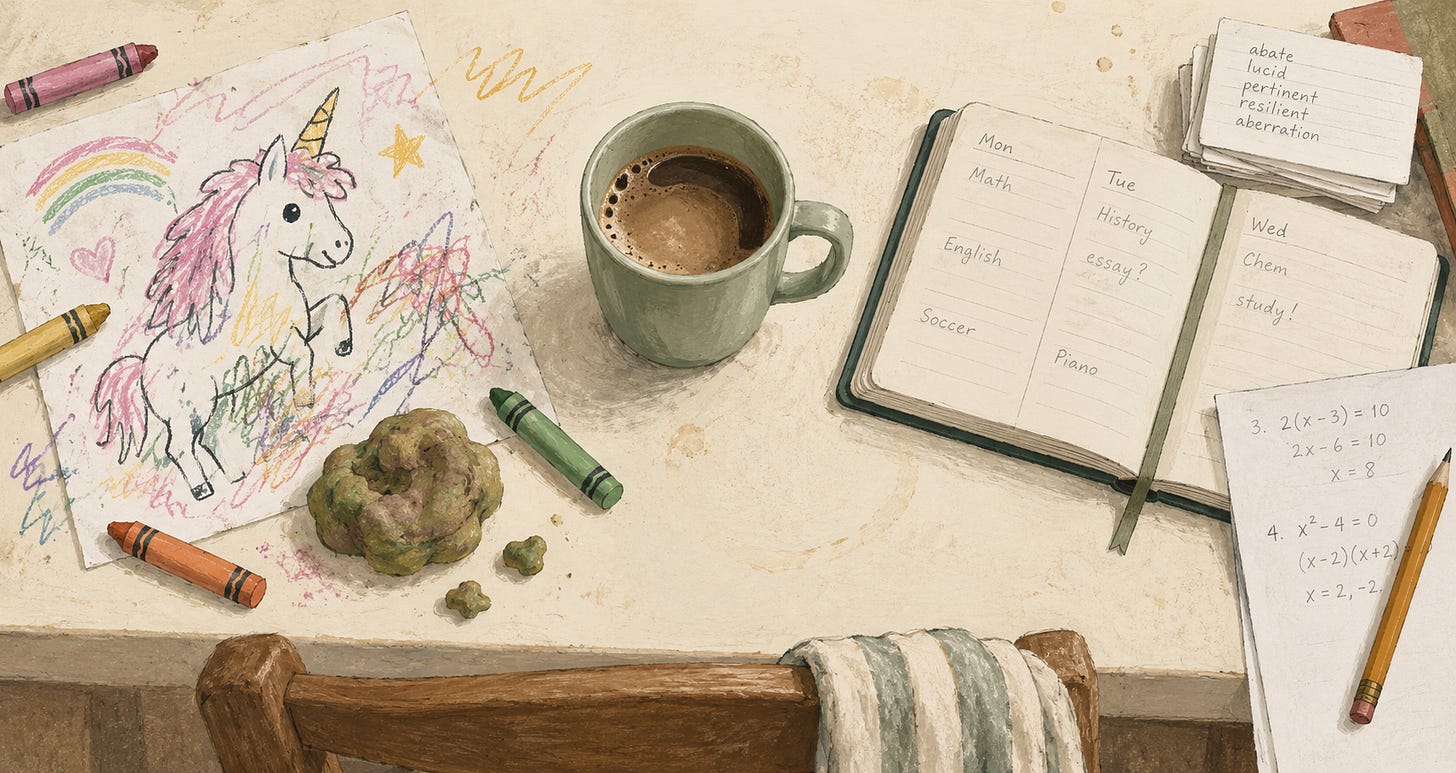
Until recently, my older daughter refused to color in coloring books. She still prefers plain paper to anything with lines because she can’t fully color inside the lines the way an older child or adult can. About five minutes after being given a unicorn coloring book (she is, much to my amusement, a stereotypical little girl who loves, in no particular order, butterflies, rainbows, ballerinas, unicorns, fairies, and princesses), she was in hysterics and the book and crayons had been thrown across the room because she “messed up” the picture. We’ve since progressed to naming the feeling (“I’m frustrated”) and reinforcing process over outcome: if we keep trying, we’ll get better. We can do hard things. Daniel Tiger and The Magical Yet have been excellent supplementary aids here.
Through my work, I’m privy to what this tendency looks like a decade later: a high-achieving middle schooler preparing for the ISEE shuts down when they encounter imaginary numbers for the first time because the material is (appropriately) unfamiliar. A lack of immediate understanding somehow signals failure to them. They panic at the slightest hint of unfamiliarity because they’re used to being good at school and not needing something explained twice.
I do recognize that I am parenting from a place of psychological privilege: growth mindset, Dr. Becky, and the gentle parenting movement were not nearly as prominent in the parenting zeitgeist when my current students, let alone past students, were my children’s ages. There was a different parenting context eighteen years ago that was nowhere near my radar. Eighteen years ago, I was teaching SAT prep classes at a Kaplan center in the East Village three blocks away from my NYU dorm because it paid better than being a barista and the job advertisement said “acting experience preferred.” (It has obviously worked out quite well.) And I know that despite my awareness of my older daughter’s perfectionist tendencies and our efforts to address them, outcomes, like test scores, aren’t guaranteed by knowing the “right” approach.
There’s a temptation as a parent to control how your children do things. That’s largely, from what I can tell, based on what you wish you had done differently in the past or how you wish you had been parented. Parents of straight-A students who wait until the day before to start studying for a test that they ace anyway worry about executive functioning issues. While I can certainly understand the concern that their child isn’t studying early enough and may be setting themselves up for disappointment, if the student has demonstrated their grasp of the material, does it really matter? There’s a fine line between a process that actually causes problems and one that triggers parental anxiety.
By letting my daughters mix up all the Play-Doh colors and collect every throw blanket in the apartment into a pile on the floor, I’m training for the eventual challenge of accepting a future preferred routine that I wouldn’t choose. My discomfort over their harmless preferences is mine to manage so I can give them room to learn about themselves and how they work best. Eventually, they should know themselves better than anyone else does, and it’s my job to facilitate that discovery.
And I hope that I’m setting the stage for them to be able to come to me with the truth. I see teenagers anticipating their parents’ reactions and perpetuating a lie or cover-up because of fear. It’s hard for most of us to admit a mistake, but it’s harder when you’re a teenager and scared of how your parents will respond to it. A high school sophomore with ADHD I worked with several years ago was terrified to tell his parents that he had failed a chemistry test. He didn’t want them to think he was stupid and was afraid that they would yell at him. I reassured him that his A grades in humanities classes and ability as a writer were evidence enough that he wasn’t stupid but it was wholly possible his parents would yell at him. But after they yelled, they would likely work with him to figure out why he failed and make sure he had the support in place so it didn’t happen again.
While I do my best to not yell at my kids, I’m not perfect. I had never been overstimulated in my life until I had two children with a 21-month age gap. When I’m running on fewer than five hours of sleep because my older daughter has figured out how to leave her room in the middle of the night and come into ours in 90-minute intervals to demand milk, snuggles, a bedtime story, and answers to questions ranging from Why can’t we see the stars in New York City? to If I go on a plane again, will I fly on the wing?, it’s hard to not yell when both girls are up at 6:30 that morning, I haven’t had a sip of coffee yet, and they’re fighting over who gets to play with the $7 mermaid water game we bought at the aquarium. Despite the occasional less than stellar responses to these moments of frustration (whose? I don’t even know), responding from a place of overstimulation and frustration (and little sleep) is distinct from being approachable. If I do yell, I try to make as immediate a repair as possible: Mommy is so cranky because she didn’t sleep well, but that’s not a reason to yell. I love you always, and I’ll try to do better next time.
Here’s the rub: it’s easier to access patience and perspective when it’s someone else’s child. I’m learning alongside my daughters, and I’m imperfect. And my own investment in their health, happiness, and ability to thrive makes my own advice actively harder to follow, which I think is a foundational irony of parenting. And despite my hopes that my professional life will automatically earn me the title of “cool mom” when my daughters reach their adolescence, they will inevitably believe that Mommy has no idea what she’s talking about. But I hope that I’ve empowered them to make their own decisions, stay true to their own preferences, and own their mistakes, even if they make choices I disagree with. All I can do is control my own imperfect reactions and hope that any disagreement we have doesn’t prevent them from telling me what happened or asking for help.
This piece also appears on our Substack. Read it there or subscribe to get new essays on testing, admissions, and learning in your inbox.