I spend a lot of time watching students get math questions wrong that they know how to solve.
I’m not talking about questions that are too hard or concepts they haven’t learned. These are problems where the math itself is something they’d get right on a homework assignment, but they miss on the SAT because they didn’t read carefully enough to set it up correctly.
This happens so often that I’ve started keeping a running list of the specific misreads. It’s long. And it’s the same patterns regardless of the student or the score level.
Here’s one I’ve seen at least a hundred times.
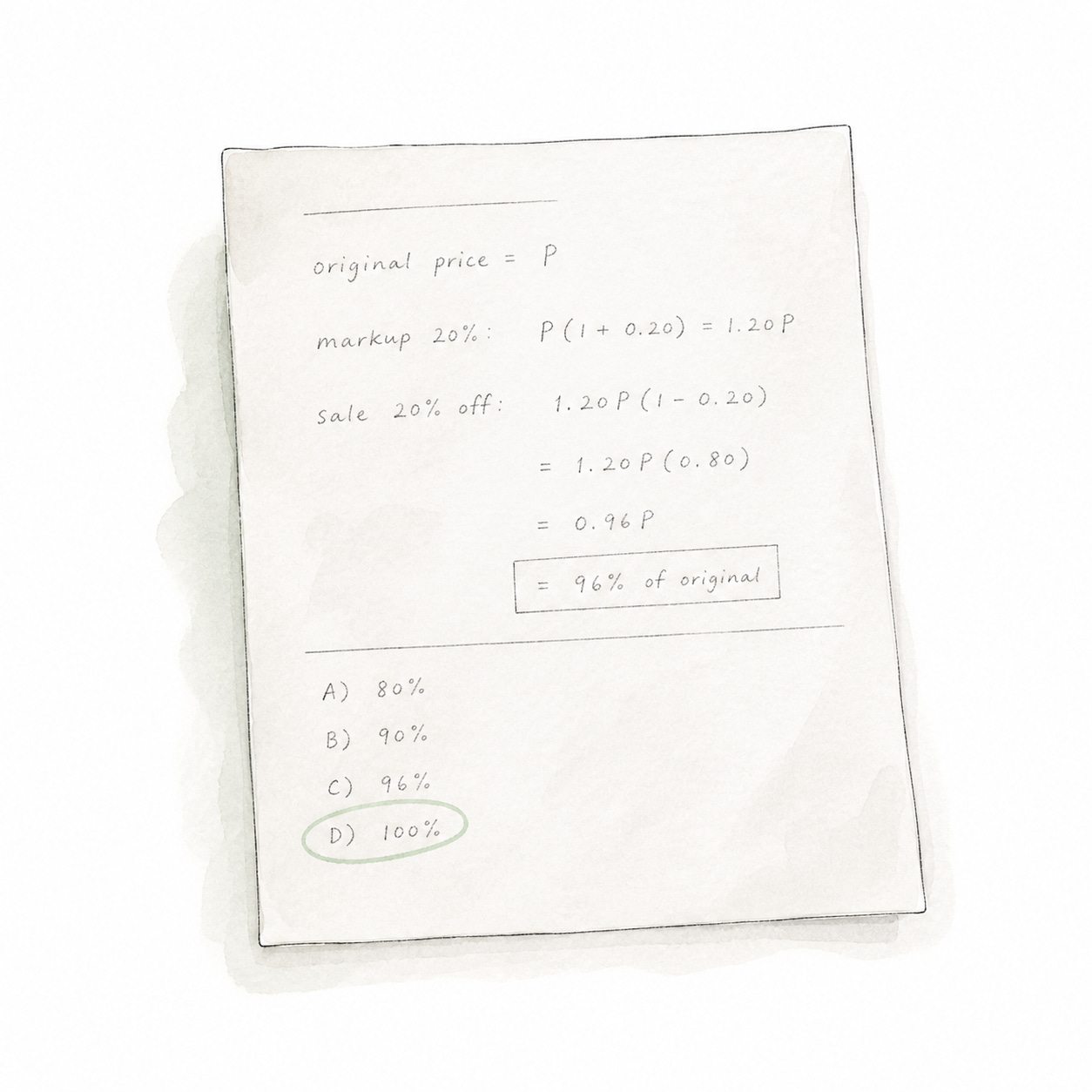
A store marks up a jacket by 20%, then puts it on sale for 20% off. What’s the final price relative to the original?
Students punch in 20 minus 20 and write “same as the original.” It feels obvious. Twenty percent up, twenty percent down, you end up where you started. But that’s wrong. The 20% discount applies to the marked-up price, not the original. You end up at 96% of the original. The math to get there is trivial: multiply by 1.2, then by 0.8. The part that trips students up is reading the problem slowly enough to notice that “20% off” is being taken off a different number than “20% up.”
The SAT does this constantly. The math is approachable. The reading is where the difficulty lives. And students who rush through the words to get to the numbers are the ones leaving points behind.
Another version of this: word problems that ask for something other than what you solved for.
A student spends ninety seconds setting up the equation, solves for x, bubbles it in, and moves on. The question asked for 2x + 1. The SAT even puts the value of x in the answer choices, knowing students will grab it.
I had a student last month who lost four questions on a single practice test to this exact mistake. She solved every one of them correctly, the algebra was right, the arithmetic was right, and she still got them wrong because she stopped reading before the last line of the question. When we went through her wrong answers, she was furious. She’d done the hard part and then thrown the points away on the easy part.
That anger is useful, honestly. Once a student sees the pattern and gets mad about it, they stop making the mistake. The fix is circling what the question is actually asking for before you start solving. Five seconds of reading saves a minute of wasted work.
The reading section has its own version of this. Students read a passage, form an impression, and pick the answer that matches how they feel about the topic. The SAT is not interested in how you feel about the topic. Every answer has to be supported by specific language in the passage, and the test is very good at putting plausible-sounding options that aren’t actually backed by the text.
I watch students do this in sessions. They’ll read a passage about a scientific study and land on an answer that seems reasonable based on what they know about science in general. But the passage said something slightly different. The study found a correlation, not a cause. Or it applied to one population, not all populations. The wrong answer ignores that distinction. The right answer is the boring, literal one.
The shift that helps most: read the question before the passage. Go in knowing what you’re looking for. Then find the sentence or phrase that supports your answer and make sure you can point to it. If you can’t point to it, you’re guessing, and guessing on the SAT is how students who understand the material still end up with scores that don’t reflect what they know.
The tool most students underuse on the math section is the one the test gives them for free.
Desmos is built into the digital SAT. It’s a graphing calculator that sits on the screen during every math module. Most students I work with either don’t open it or use it to do basic arithmetic: adding, multiplying, checking a calculation they already did by hand. That’s a waste.
Desmos is a graphing engine. You can type in a messy equation, split it across two lines, and click where the graphs intersect to get your answer. You skip the algebra entirely. It works for radicals, absolute value equations, systems, quadratics, anything you can graph.
I put together a two-page playbook with six Desmos moves that cover the patterns I see most often on the SAT. If your student hasn’t practiced these inside the Bluebook app, the next two days are the time. The moves take about twenty minutes to learn, but they need to feel automatic before test day. Fumbling in Desmos under time pressure is slower than doing the algebra by hand. Knowing exactly what to type and what to click is faster.
The students who improve the most in the final stretch aren’t the ones who cram new content. They’re the ones who tighten the systems they already have.
Circle what the question is asking before you start solving. Know your Desmos moves cold. Check whether the problem is asking for x or for 2x + 1. All of it comes down to slowing down at the moments where the test is designed to make you rush. The students who do that are the ones whose scores actually reflect what they know.
Free resources:
- Math Guide: every concept and formula for Saturday
- The Desmos Playbook: six moves for the built-in calculator
- Percentages Guide: the strategies behind percent problems
- Reading Subtype Strategies: every question type, one approach each
This piece first appeared on our Substack. Read it there or subscribe to get new essays on testing, admissions, and learning in your inbox.