Superscoring is one of those college admissions terms parents hear once and then repeat to each other as if it settles the matter. The version I usually hear sounds something like this: It’s fine. She can bring up Math later. They’ll superscore it. Sometimes that is exactly right. And sometimes it’s how families back themselves into the wrong testing plan.
The good news first. We recently reviewed superscoring policies across sixty-three colleges that come up often in KFT conversations. The broad pattern is reassuring: most schools do superscore both the SAT and the ACT. In our review, fifty-six superscored the SAT and fifty superscored the ACT. A student really can improve one section on a later sitting and end up with a stronger composite.
That matters because it gives families room. A first or second test does not have to be perfect in every section to stay strategically alive.
The part families flatten too quickly: the exceptions are not random. They are not obscure schools no one in this market is thinking about. They are exactly the schools that shape parent decision-making in the first place.
Before we even get to superscoring logic, there is a more fundamental question: does this school require a test at all?
The list of test-required schools has grown significantly in the past two years. Harvard, Brown, Dartmouth, MIT, Georgetown, Cornell, Johns Hopkins, Stanford, Penn, UT Austin, and Yale all require scores now. (Our college testing policies page keeps the full, current list.) If a school on the list is test-required, the conversation is not about whether to test. It is about how to test strategically.
From there, the superscoring question gets more specific. If a family is deciding whether to stay with the SAT, move to the ACT, or register for one more sitting in September or October before early decision deadlines, the policy matters only insofar as it changes what kind of gain is actually useful. A plan built around sectional improvement is a very different plan from one built around needing a stronger whole sitting.
That distinction is where a lot of families lose time.
This is why I get nervous when a family says, “We’ll just superscore it later.”
That sentence sounds practical. Sometimes it is. But it only works if the colleges on the list actually reward the kind of improvement the student is likely to produce.
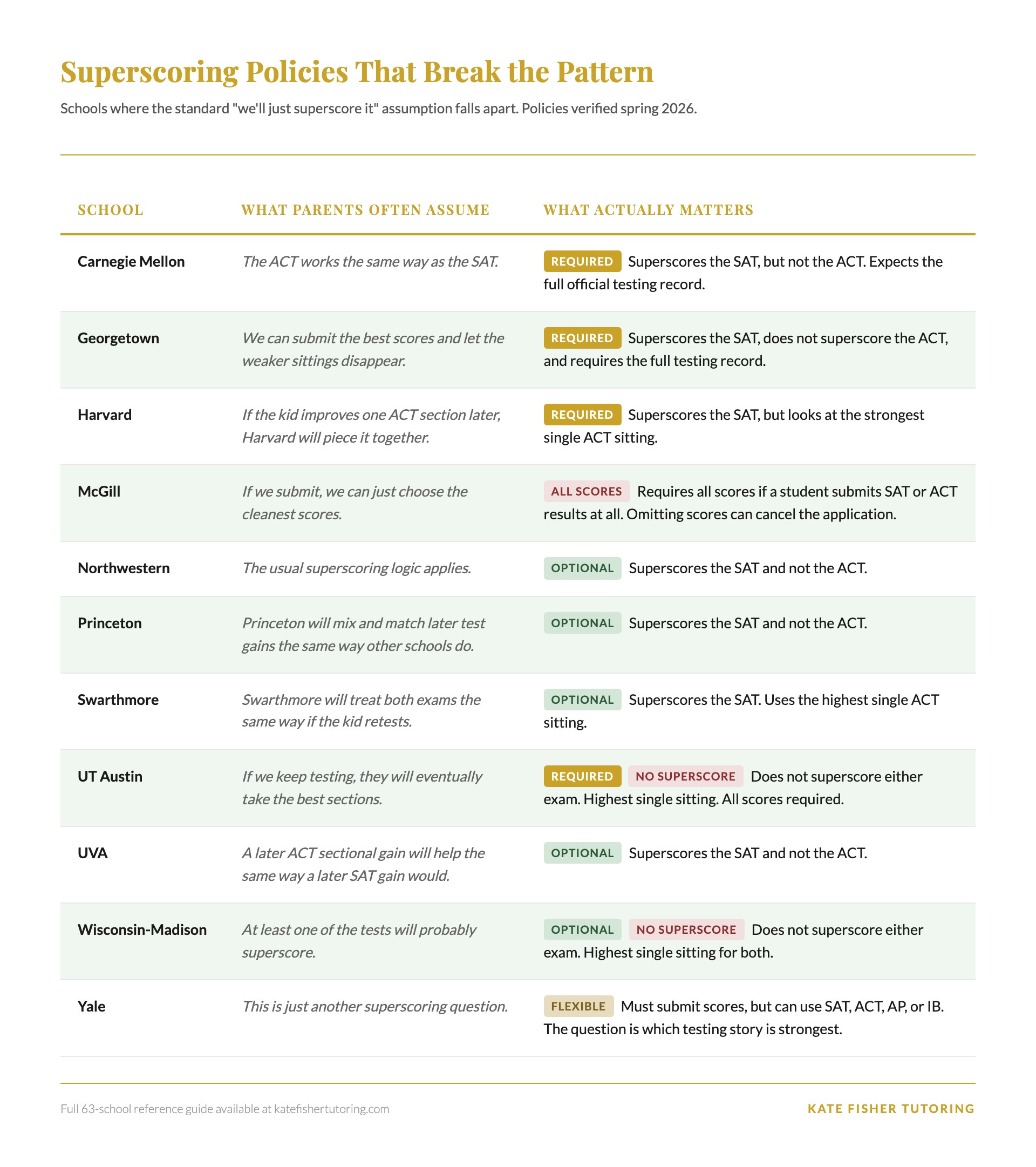
Take Georgetown. If a student is applying there and the family is counting on an ACT retake to patch one section, that is not a small oversight. Georgetown does not superscore the ACT, and it requires the complete testing record. Repeated weaker sittings are not invisible there.
Or Harvard and Carnegie Mellon. Both test-required, and neither treats the SAT and ACT as interchangeable for superscoring. If the family’s plan depends on piecing together ACT improvements across multiple dates, that plan may not work the way they think.
Then there is the other bucket, which families miss just as often: schools where superscoring is not helping on either exam. UT Austin is the clearest example. It is test-required, does not superscore, and requires all scores. If a family is planning repeated sittings under the assumption that only the best sections will matter, that school should change the conversation immediately.
McGill is worth flagging for a different reason. It is not just a superscoring question. It is a reporting question. If a student chooses to submit SAT or ACT scores, McGill expects all of them. Failure to do that can cancel the application.
And Yale is its own category. The real question is not Can we superscore? It’s What is the strongest testing story this kid can present? SAT, ACT, AP, IB: all are on the table. Sometimes that still points to the SAT or ACT. Sometimes the answer is more complicated than families expect.
A couple of secondary wrinkles that trip people up more than they should: Boston University will only accept ACT scores that include the Science section. Caltech requires all official scores and then reviews them through its own internal bucket system. Neither of those is the headline for most families, but they are exactly the kind of details that get missed when everyone assumes every policy is basically the same.
The larger point is not that superscoring is bad news. For many competitive colleges and universities, a smart, targeted retake can absolutely be worthwhile. If a kid is stronger in one section on one day and another section on another day, many colleges will let that help them.
The problem is that families remember the general rule and forget the schools that break it. And those schools are often the ones with the most pull over family behavior.
This matters especially in April, because the remaining testing calendar for students applying for Fall 2027 admission is short enough that strategy mistakes can pile up fast. If a student has June, July, September, and October left before early decision deadlines, every sitting should have a clear job. Are we chasing a genuine superscore opportunity? Are we trying to produce one clearly stronger whole sitting? Are we choosing between SAT and ACT based on actual college policy, or on the idea that all scores will be mixed and matched later? These are not the same plan.
The families who use the spring and summer well are not usually the ones who do the most. They are the ones who get specific earlier. They look at the college list, the actual score pattern, and whether the next gain is likely to be sectional or global. Then they decide whether the next test date is worth taking. That is the kind of thinking superscoring should lead to.
So yes, the headline is still reassuring: most colleges do superscore. But if your retake strategy works only because you are assuming superscoring will save you, check the actual policy first.
This is one of those parts of admissions that sounds simple right up until it isn’t. And that is usually where the real advising begins.
We put together a full superscoring reference guide with policies across sixty-three schools. You can download it here.
This piece first appeared on our Substack. Read it there or subscribe to get new essays on testing, admissions, and learning in your inbox.