If your child is a sophomore at an independent school in New York City, you’ve probably already started hearing about this. The school may have sent information about on-site practice testing. Other parents are mentioning it. The Class of 2026 college decisions are rolling in right now, and it has a way of making the timeline feel suddenly, concretely real.
That awareness is well-placed. NYC families move through this process earlier than most of the country, not as a cultural quirk but because the admissions calendar here actually requires it. Sophomore spring is when the groundwork gets laid.
There’s also a practical reason to get oriented right now: both major tests underwent significant overhauls in the last three years. The SAT went fully digital in 2024. The ACT launched a substantially revised version in 2025. A lot of the information circulating from older siblings, from parents who went through this recently, from the internet generally, is already out of date. What follows is current.
Let’s get into it.
Why Sophomore Year Is the Decision Year
The NYC testing timeline, practically speaking, looks like this: take a diagnostic in the spring of sophomore year, select a test by early summer, and use the summer to do the bulk of prep. That sequencing sets students up to walk into junior year ready to test rather than still getting ready.
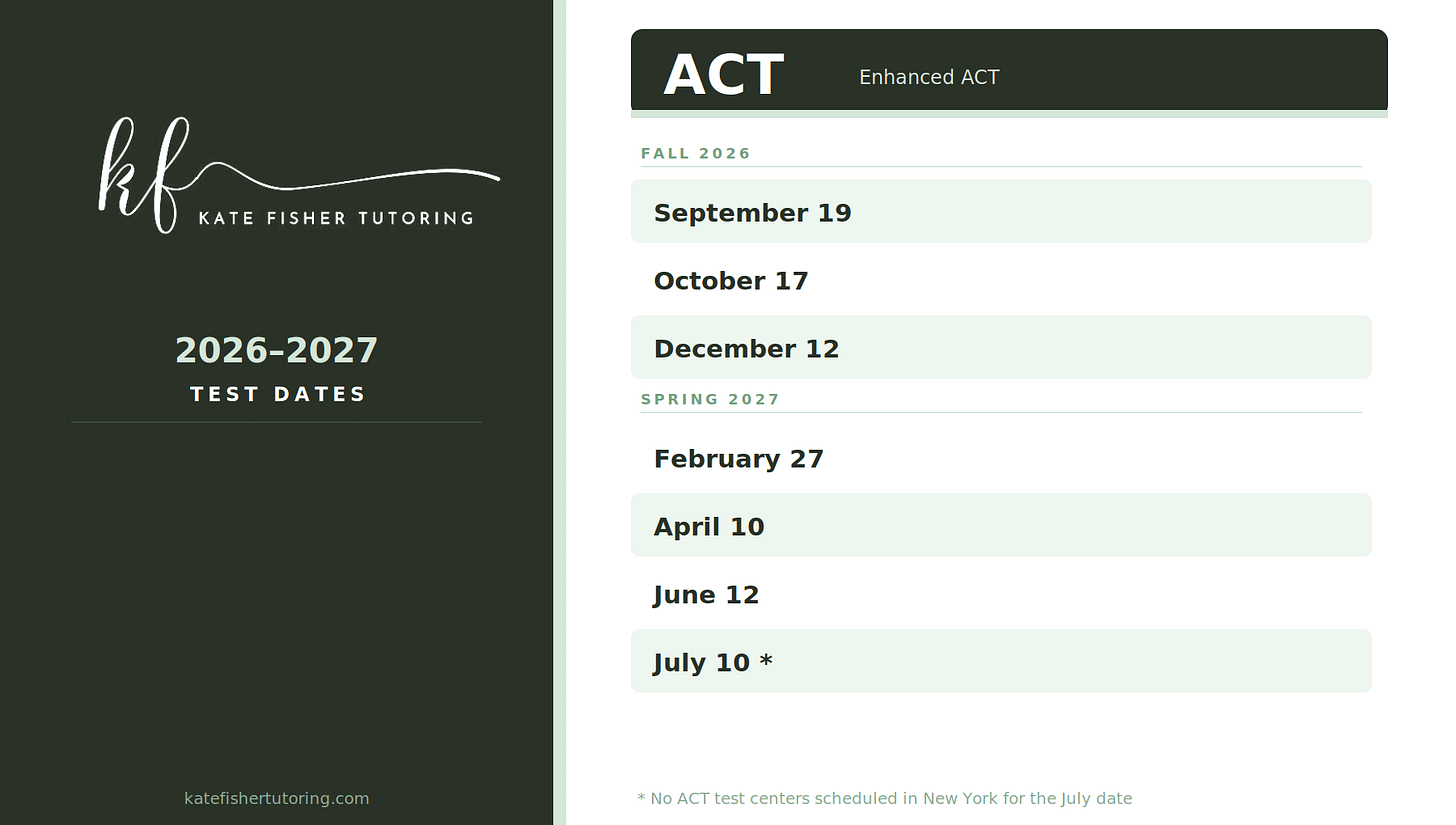
The test date options are generous. ACT dates in the fall include September, October, and December. SAT dates run August, September, October, November, and December. A student who preps seriously over the summer can realistically be done with testing by the end of fall junior year.

That matters beyond the testing calendar. Junior year grades and extracurricular involvement are critical components of a college application. In many ways, they carry more weight than the test score itself. A student who arrives at junior year with testing largely behind them can give those things the attention they deserve instead of splitting focus across all of it at once. The summer is the window where that works cleanly in a student’s favor.
Junior year is when students take the test. Sophomore year and the summer that follows are when they get ready. The decision about which test to take is worth making thoughtfully, with real information, instead of quickly and under pressure. The two tests are different in ways that matter for individual students, and the right answer varies. Two full-length diagnostics taken this spring are where that process starts.
The ACT Just Changed. Here’s What That Actually Means.
The ACT’s Enhanced version rolled out fully in September 2025, and it’s the most significant structural change to the test in decades. It’s shorter (the core test now runs about two hours, down from roughly three) but the changes go deeper than that.
The core test covers three sections: English, Math, and Reading, totaling 131 questions. Science, previously a required fourth section that factored into the composite score, is now optional. Students who take Science receive a separate score for it that doesn’t touch the composite. The composite is still on a 1-36 scale, calculated as an average of English, Math, and Reading only.
The test is also available in a digital format for the first time. More on why that matters less than it sounds.
The Enhanced ACT is shorter and less punishing in terms of pacing. It is not, as some have suggested, now basically the same test as the SAT. The two tests are closer in length than they’ve ever been. On almost everything else, they’re still quite different.
What’s Actually Different, and What It Means for Your Kid
Reading: shorter isn’t the same as easier
The SAT uses short passages, sometimes just a few sentences, with one question per passage. At first glance, this sounds more manageable than the ACT’s approach of longer passages with nine questions each. It often isn’t.
SAT reading passages are dense. The vocabulary is elevated, the syntax can be deliberately complex, and the questions are built on inference and interpretation rather than retrieval. Students who are not strong readers, or who read carefully but literally, often struggle here not because they can’t get through the text but because they can’t navigate its opacity. The questions require you to do something with the passage, not just locate an answer in it.
ACT reading is more direct. The passages are longer, but the answers are largely there in the text. Students who read thoroughly and carefully, who take the passage at face value, tend to do well. It rewards a different kind of reading than the SAT does, and for a lot of students it’s the more forgiving format.
Grammar and vocabulary: two different architectures
On the SAT, grammar and reading are fully blended in the same Reading and Writing section, and vocabulary is explicitly tested alongside grammar. Expect questions on word choice, connotation, and the precise meaning of words in context. If your kid’s verbal skills are lopsided, those strengths and weaknesses travel together on the SAT.
The ACT keeps them completely separate. English is its own section covering grammar, punctuation, sentence structure, and rhetorical choices. Reading is its own section. A student who’s an excellent reader but shakier on grammar conventions gets the full benefit of the reading section without the grammar dragging it down, and vice versa.

Math: the warm-up is gone, and the calculator is a trap
The old ACT math section had 60 questions and a built-in ease ramp. The first 15 or so were accessible, giving students a chance to settle in before the difficulty climbed. The Enhanced ACT dropped to 45 questions and dropped the ramp with it. Students now step into harder material from question one, and each question carries more weight.
The SAT has a built-in Desmos graphing calculator available for all math questions, and a lot of students love it. They should be careful. Desmos is useful for the right problems. It is not useful for the hardest SAT math questions, which require actual mathematical reasoning that no calculator can substitute for. Students who lean too heavily on Desmos during prep build a dependency that shows up exactly when it costs the most.
The SAT is heavily weighted toward algebra, with abstract multi-step problems and some open-response questions mixed in with multiple choice. The ACT covers a broader range, including more geometry, trigonometry, and pre-calculus. It’s entirely multiple choice with no formula sheet. ACT math questions tend to be more direct; SAT math at the harder end tends to be more conceptual.
The adaptive structure and what it does psychologically
The Digital SAT is adaptive, meaning your performance on the first module determines the difficulty of the second. A strong Module 1 routes you to a harder Module 2, which gives you access to higher-scoring questions. That’s good for your score. It also creates an experience that catches students off guard.
Module 1 is designed to feel manageable. For a well-prepared student, it often does. Then Module 2 arrives noticeably, sometimes dramatically, harder. Students who sailed through Module 1 walk in feeling confident and encounter questions that feel like a different test entirely. The adjustment required mid-exam, without warning, is real, and students need to be prepared for it going in.
The ACT is linear. Every student gets the same test and difficulty increases gradually and predictably across each section.
Experimental questions: the ACT’s hidden variable
The Enhanced ACT embeds unscored experimental questions inside each section, questions that are being field-tested for future exams that contribute nothing to a student’s score. In English, 10 of the 50 questions are experimental. In Math, 4 of the 45. In Reading, an entire passage is experimental, meaning only 27 of the 36 questions actually count toward the score.
Students have no way of knowing which questions are real. This doesn’t change how you take the test; you treat every question as if it counts, because you don’t know which ones don’t. But the effective question count is lower than it appears, which compresses the scoring range and reduces the ability to recover from a rough patch through volume.
Scoring transparency: the SAT loses this one
The SAT’s scoring is a black box. Different questions carry different point values and the College Board doesn’t publish which ones or explain the weighting. When students receive their official score reports, the information is remarkably unhelpful. You won’t come away with a clear picture of where points were lost, which questions caused trouble, or what to prioritize in the next round of prep.
The ACT’s scoring is transparent. Every question counts equally. The composite is a straightforward average of the three section scores. And on select test dates, the ACT offers its My Answer Key program: for a fee, students can purchase a copy of their actual test questions, their answers, and the answer key. That means a student and tutor can sit down after an official test, go through every question, and understand exactly what happened and why. It’s a genuinely useful diagnostic tool that the College Board removed when the SAT went digital and has not brought back.
The Science section: now a decision, not a given
Science used to be a fixed part of the ACT composite. It no longer is. For most highly selective colleges, Science is optional and won’t affect the composite score either way. A handful of schools (MIT, Boston University, Rutgers, and Marquette among them) still recommend or require it, particularly for STEM applicants.
For NYC students targeting a broad range of selective colleges, the working default right now is to take Science and report it only if it strengthens the application. College policies are still evolving and worth verifying against a specific target school list.
Paper vs. digital: not a trivial choice on the ACT
The SAT was designed as a digital test from the ground up. The adaptive structure, the interface, the question formatting, all of it was built for a screen. The Enhanced ACT digital version is a paper test that was moved online, and the experience reflects that. For students taking the ACT, paper is the better choice and still widely available. Students who work better on paper, or who have accommodations that function better in that format, have a real option here that doesn’t exist with the SAT.
The Diagnostic Is the Decision
The most useful thing a family can do right now is have their student take a full-length diagnostic of each test: cold, no preparation, just the test itself. Not a quiz. Not a sample section. A full test.
The scores will tell you things that research and profile-matching won’t. Where a student’s time breaks down, how they handle the pacing demands of each format, where the content gaps are, whether the reading style of one test suits them significantly better than the other. These things are hard to predict in advance and easy to see on a practice test.
The diagnostic isn’t just the first step in test prep. It is the decision.
A Few Things That Are Specific to NYC
Competitive NYC applicants are generally aiming for 1500 or above on the SAT, 34 or above on the ACT. The margin for error at those score targets is small, which means the prep timeline has to reflect that.
Superscoring policies vary by school and matter more than most families realize. Some schools superscore aggressively; some don’t superscore at all; some have policies that shifted when the ACT changed its composite calculation. Knowing your target school list before committing to a test is worth the effort.
The One Thing to Do This Spring
Take the diagnostic. Both tests, full length, as close to real conditions as you can manage. Everything else (which test, which timeline, how many retakes) follows from that.
If you’d like help setting that up, or want to talk through what the results mean once you have them, that’s exactly what we do. Reach out here to book a consultation with us.
This piece first appeared on our Substack. Read it there or subscribe to get new essays on testing, admissions, and learning in your inbox.