The ACT Reading section often feels like a race against the clock (with standard timing, you have 35 minutes to answer 40 questions spread out across 4 passages), and traditional strategies like skimming, summarizing, or reading the whole passage before diving into questions don’t work for everyone. In fact, they might leave you scrambling and second-guessing.
In this post, I’ll walk you through an entire passage and question set using my strategy. You’ll see how I tackle the questions in a specific order, starting with line-referenced questions, then moving to those anchored by keywords like proper nouns or dates, and saving the big-picture questions for last. This process allows students to focus their reading on only the parts of the passage that matter, reducing overwhelm and maximizing time.
Let’s break down ACT Reading and see how this strategy can transform your approach.

Beware: this post is long and super in-depth. Here’s a quick overview of the strategy we’re about to dive into:
- Skip the Passage: Start with the questions to focus your reading on what matters most.
- Answer in Order of Ease:
- Questions with line references
- Questions with proper nouns or dates
- Questions with passage-specific keywords or phrases
- Leftover non-main idea questions
- Main idea/main purpose questions last
- Key Principle: ACT Reading is open-book. Don’t read for the sake of reading. Target answers efficiently.
- Proven Results: Using this method, you’ll save time, reduce stress, and improve accuracy.
Here’s the ACT Reading passage we’ll be working with! It’s Passage II, which is always Social Science. Remember that one of the four passages on ACT Reading will be a paired passage (it can be any of the four), but this is a normal passage.
If you want, try to answer these questions on your own and see how long it takes you to complete them. I’ll reveal the correct answers to all over the course of this post, so you can check your work.
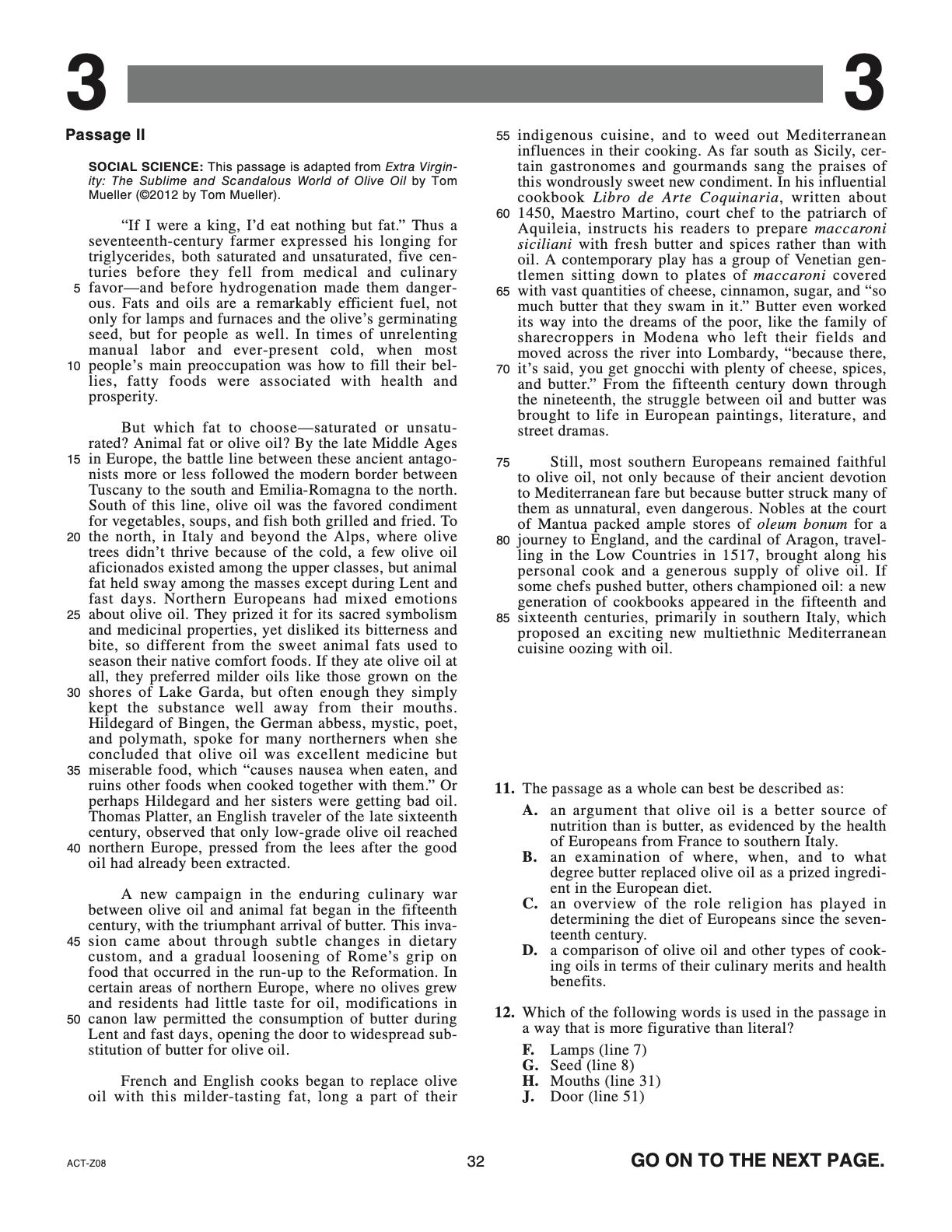
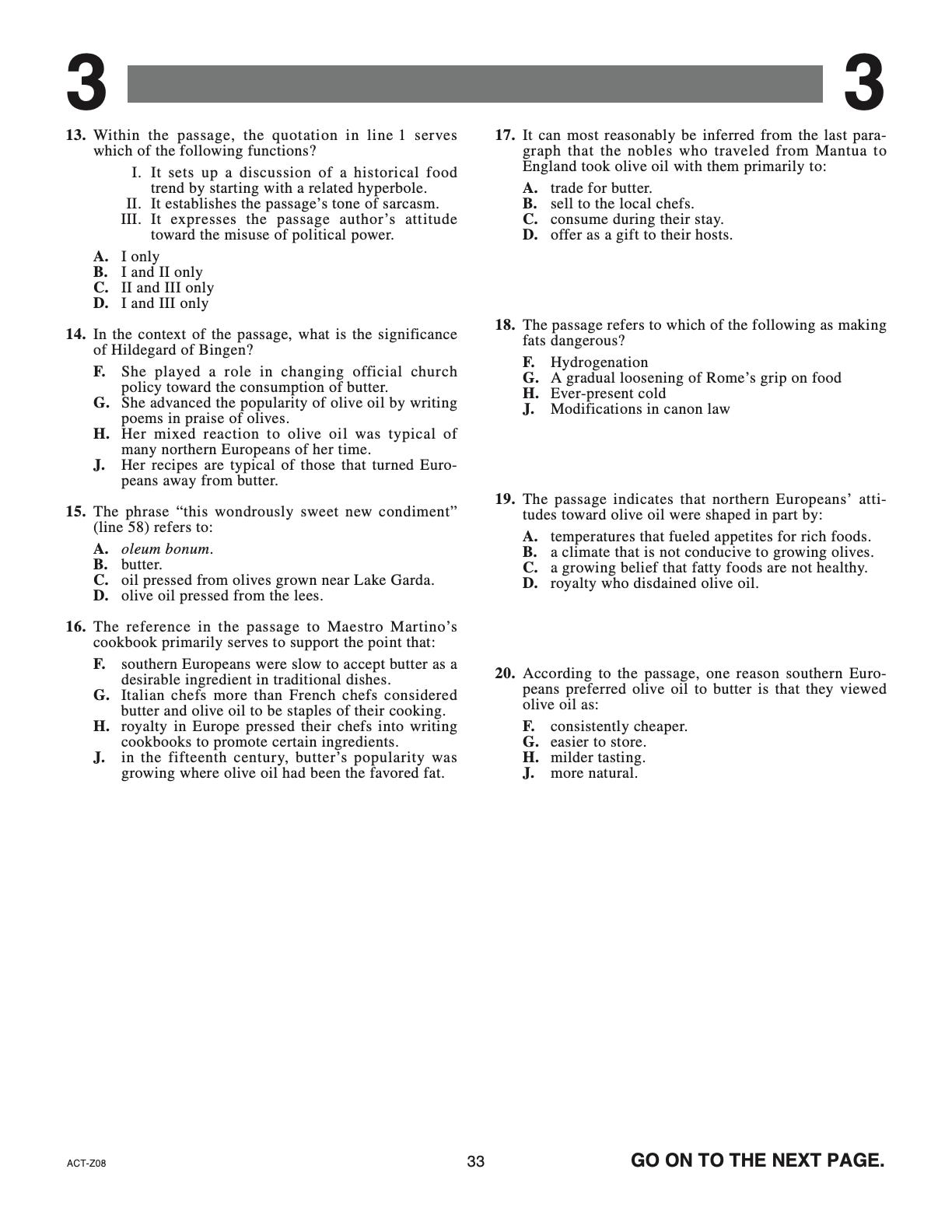
Step 1: Go Straight to the Questions
The fundamental principle behind my approach is that we’re going to jump over the passage and go straight to the questions. ACT Reading is open-book. You’ll always refer back to the passage for answers. Skipping the passage lets us dive straight into finding answers. And throughout this post, you’ll see that many of the answers are in the passage almost word for word.
Step 2: Answer Questions with Line Numbers
If the whole point is to look for the answers in the passage, it’s a no-brainer to start with questions that literally direct you to specific points of the passage.
In this set, we have two questions with line numbers: Question 13 and Question 15.
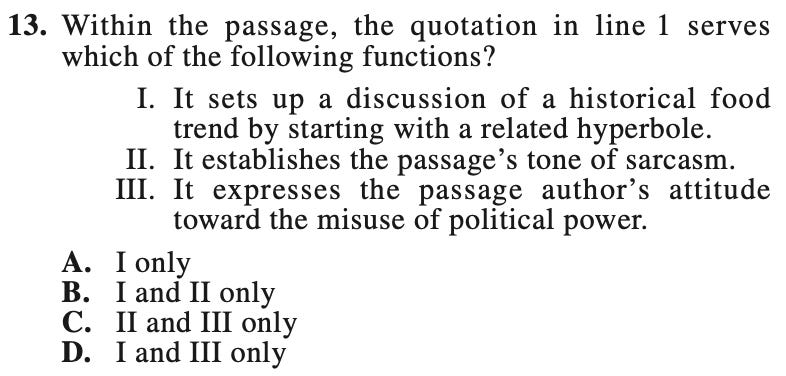
Even though this question has a line reference, we’re going to skip it for now because of what the question is asking. It wants to know the purpose of the quotation in line 1 within the context of the whole passage. We haven’t read any of the passage! We don’t even know what it’s about! We’ll save this for later.
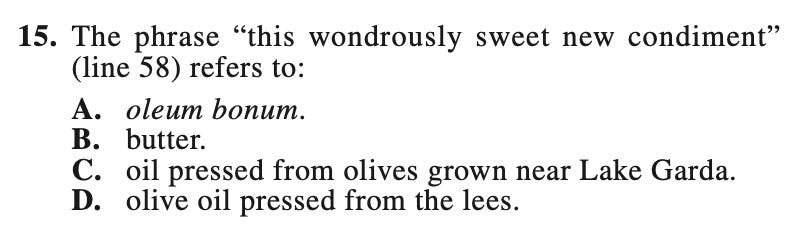
While this may look like an ordinary vocab-in-context question, it’s not. Vocab-in-Context questions almost always take the format, “In line x, “word” most nearly means.” Here, we’re asked what the phrase “this wondrously sweet new condiment” refers to.
Tip: On ACT Reading (and also on SAT Reading!), when you see words like “that” or “this,” it’s generally a signal to read the previous sentences. In this question, for example, “this wondrously sweet new condiment” is expanding on whatever condiment is previously mentioned. Let’s go find it.
Let’s go to line 58. The golden rule of this strategy is that you always want to read at least the full sentence a line number is part of. Don’t just read the line or the phrase mentioned, but a little bit before and/or a little bit after as indicated.

Here’s the sentence that contains the phrase the question pointed us to; as you can see, we have no idea what “this wondrously sweet new condiment is yet.” Let’s read the sentence before.


There’s a little more information here. We now know that “this wondrously sweet new condiment” is also “this milder-tasting fat.” Remember, that “this” in front of “milder-tasting fat” tells us that whatever it is will be defined in a previous sentence.
If we look at the last sentence of the previous paragraph, we’ll find our answer:
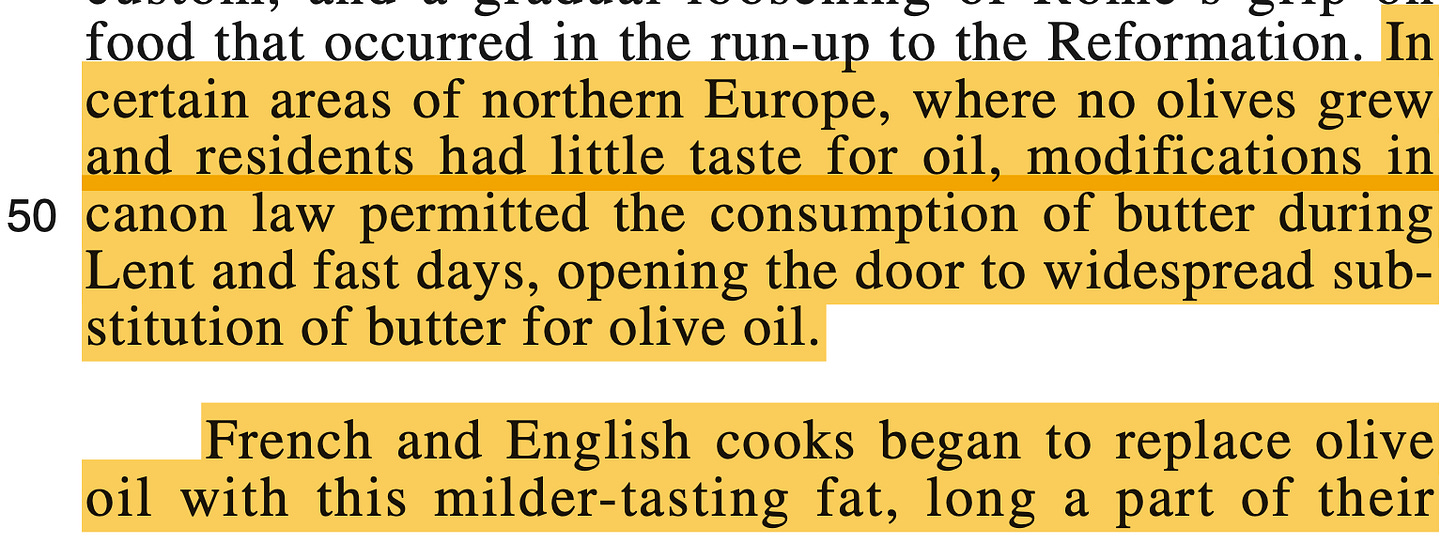
Do you see the answer? If not, look again:
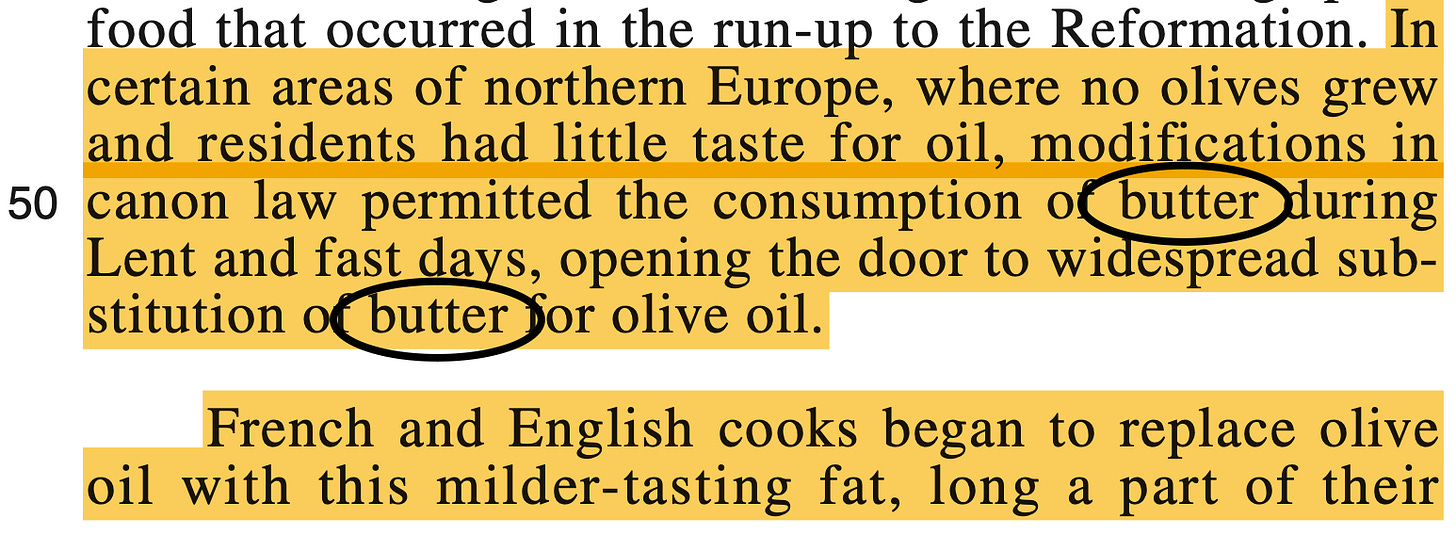
The answer is butter! If we go back to the question…
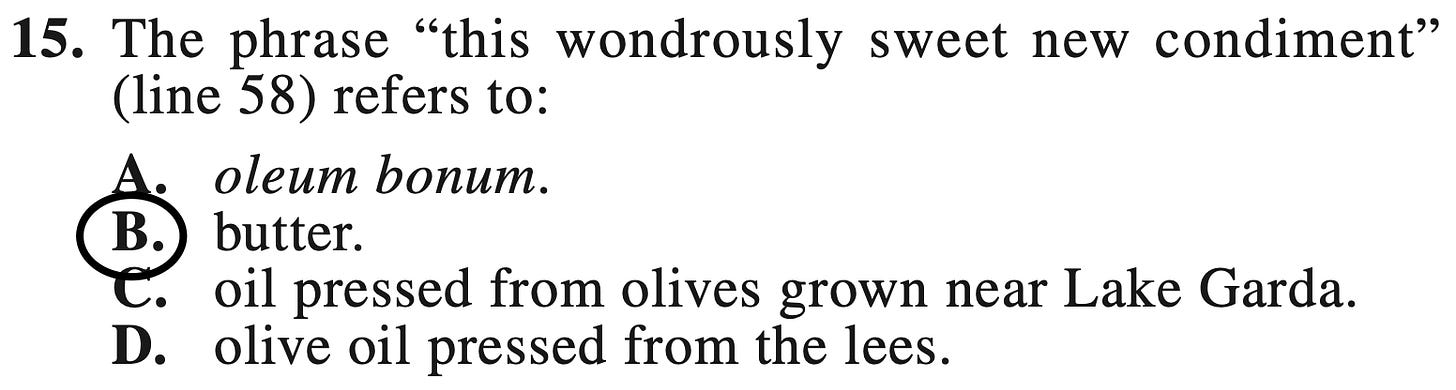
…our answer is clearly B, butter.
Step 3: Answer Questions with Proper Nouns/Dates
Once you’ve exhausted the easier line number questions, look for questions that have proper nouns (dates, locations) or dates. Proper nouns are capitalized, so they’re easier to find in the mass of text that is the passage. Likewise, dates standout because they’re numbers rather than letters.
Half of the questions in this passage set use proper nouns: #14, 16, 17, 19 and 20.
Let’s start with Question 14.
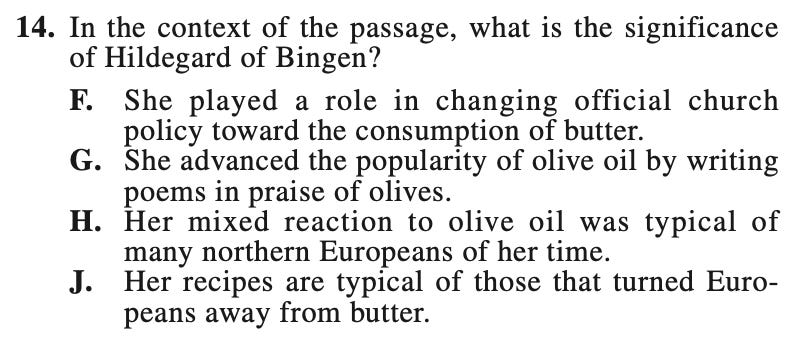
The proper noun in this question is Hildegard of Bingen, which should be easy enough to find in the passage. If we scan the passage, we’ll find Hildegard mentioned in line 32. Let’s read around those lines.
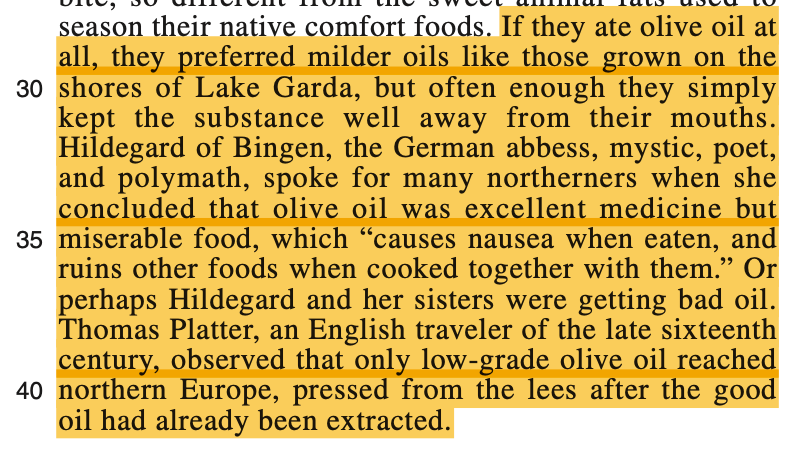
Do you see the answer? Hildegard is mentioned as having an opinion that many northerners did, basically that olive oil was great as medicine but not so great as food. Make sure you keep reading after the quotation from her, though. The passage continues to say that “perhaps Hildegard and her sisters were getting bad oil”; this point is further emphasized by the inclusion of Thomas Platter’s observation “that only low-grade olive-oil reached northern Europe.”
Let’s try to answer the question ourselves before going back to the answer choices. What is the significance of Hildegard of Bingen? Her opinion reflects that of northern Europeans, who did not have access to good olive oil.
Now, we can go find a match in the four answer choices.
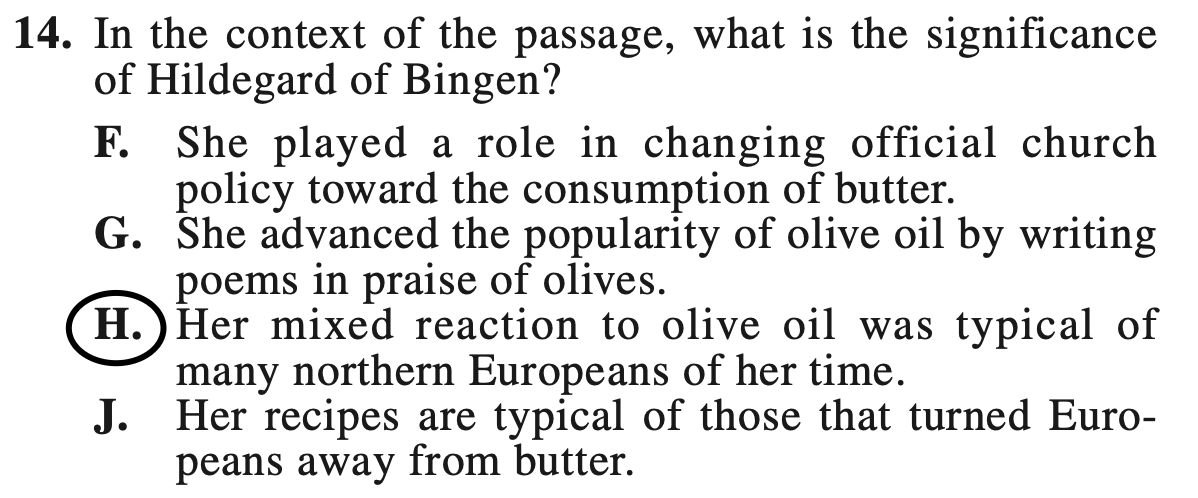
Boom! H is undoubtedly the answer: Her mixed reaction to olive oil was typical of many northern Europeans of her time.
Tip: Notice how after we read the necessary lines to answer this question, we answered the question in our own words before looking at the answer choices. This is a critical strategy. By doing this, you can select the correct answer more confidently and avoid getting sucked into wrong answer traps.
Let’s look at another proper noun question: #16.
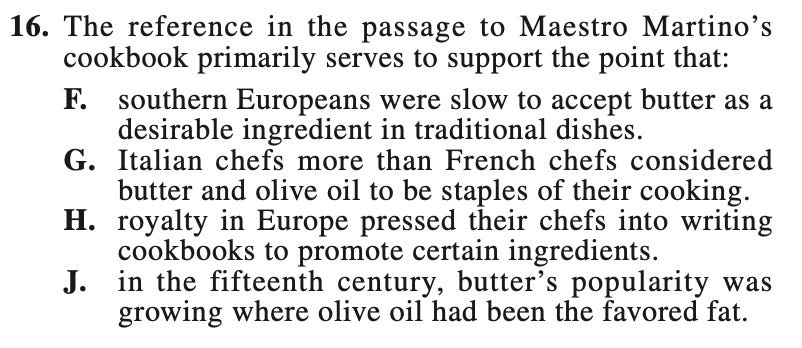
Here, the proper noun is Maestro Martino. Let’s do what we did for the previous question: find Maestro in the passage, read around the lines he’s mentioned in, predict an answer, and find the match.
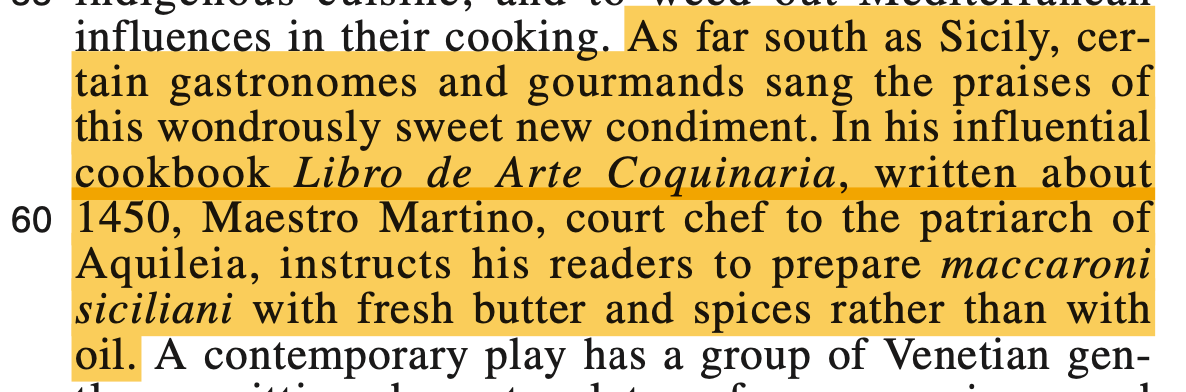
Remember, we read the first sentence of the highlighted section (and a few before it) while answering Question #15, so we already know that this bit comes after the discussion of how “this wondrously sweet new condiment” (which we found out was butter) replaced olive oil for some.
So, what does the reference to Maestro Martino support? In his cookbook from 1450, he “instructs his readers to prepare maccaroni siciliani with fresh butter and spices rather than with oil.” The answer, in essence, should be something about how butter was preferred over oil. Let’s find our match.
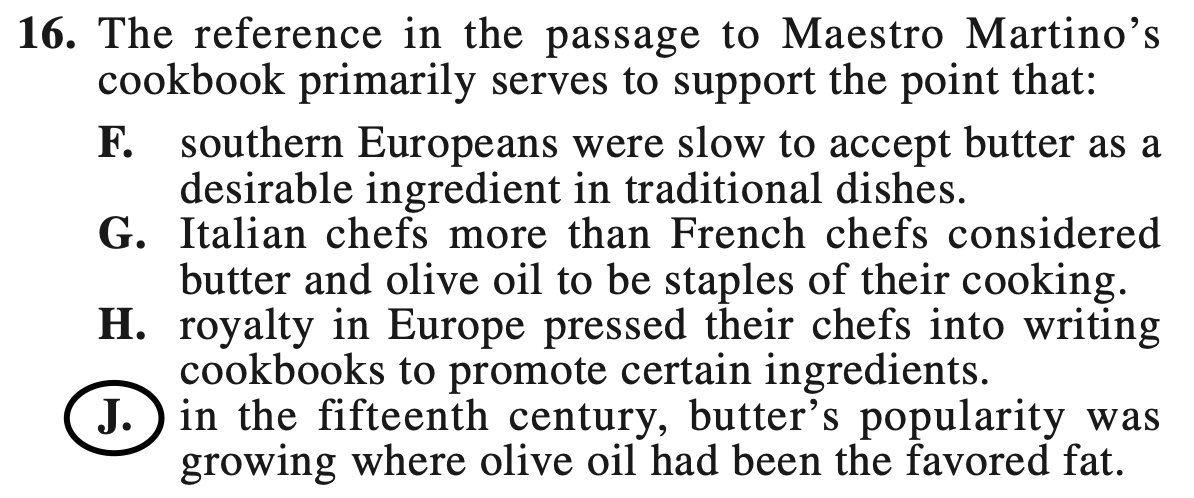
There it is: J, in the fifteenth century butter’s popularity was growing where olive oil had been the favored fat.
Note that the information we had read when answering Question 15 helped us better answer this question.
Let’s keep going! Next up is Question 17.
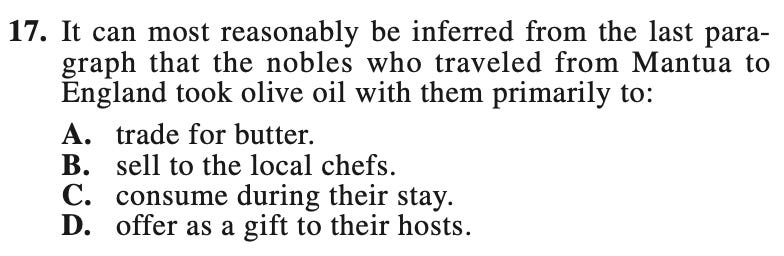
This is an inference question (“It can most reasonably be inferred”), which means that the answer will not be in the passage word for word. We’ll need to connect the dots based on what is in the passage. Be careful with inference questions. You don’t want to choose an answer that goes way beyond the information we’re given.
In this question, we’re looking to find a probable explanation for why “the nobles who traveled from Mantua to England took olive oil with them.” Let’s scan the passage for "Mantua to England” specifically because those are the proper nouns in the question.
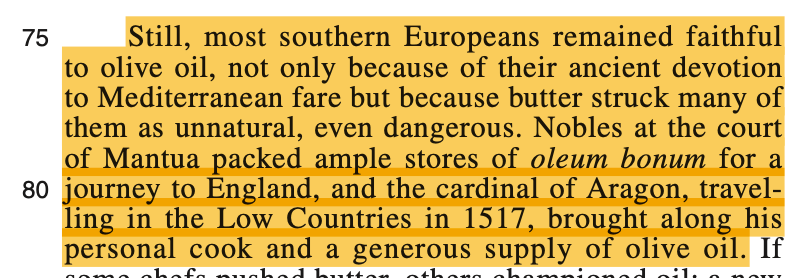
We can find the nobles in question in the second sentence of the last paragraph: “Nobles at the court of Mantua packed ample stores of oleum bonum for a journey to England…” The sentence goes on to tell us about how the cardinal of Aragon also brought “a generous supply of olive oil” along during his travels.
But why? Let’s look at the previous sentence to see if that sheds light on the issue. We learn that “most southern Europeans remained faithful to olive oil, not only because of their ancient devotion to Mediterranean fare but because butter struck many of them as unnatural, even dangerous.” So…the southern Europeans (like the nobles who traveled from Mantua to England) preferred olive oil for a few reasons. In traveling to an area that was on the butter side of the olive oil vs butter debate, the nobles probably brought olive oil with them to cook with and eat so they wouldn’t have to use butter.
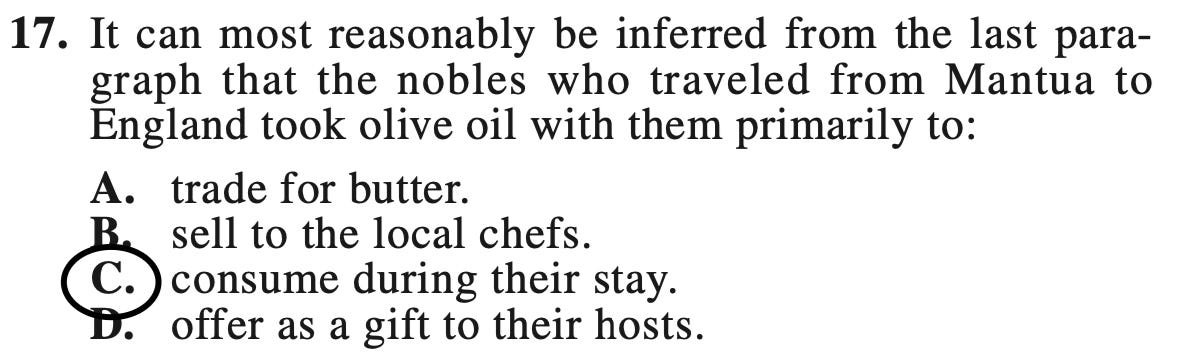
That matches C: consume during their stay.
We have two questions left in this section: #19 and #20. Take a look at them and try to figure out which one makes the most sense to answer next.
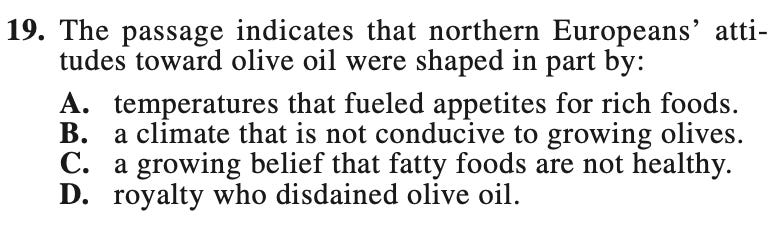
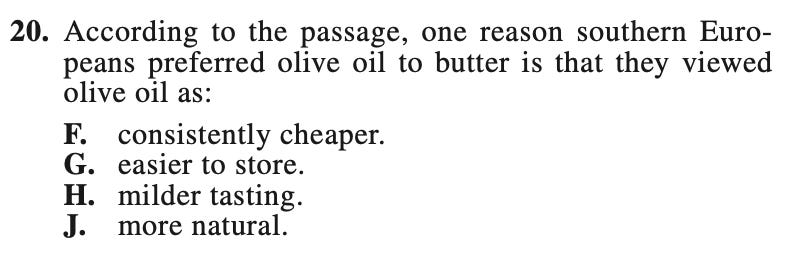
Weren’t we just answering a question about southern Europeans preferring olive oil to butter to such an extent that they literally brought it with them while traveling so they wouldn’t have to consume butter? We can answer Question #20 without doing any more reading.
The lines we read for Question #17 said that “most southern Europeans remained faithful to olive oil, not only because of their ancient devotion to Mediterranean fare but because butter struck many of them as unnatural, even dangerous.”
Be careful with the wording of the question here. The answer choice refers to olive oil. So, if southern Europeans viewed butter as “unnatural, even dangerous,” that means they found olive oil “natural” and “safe.”
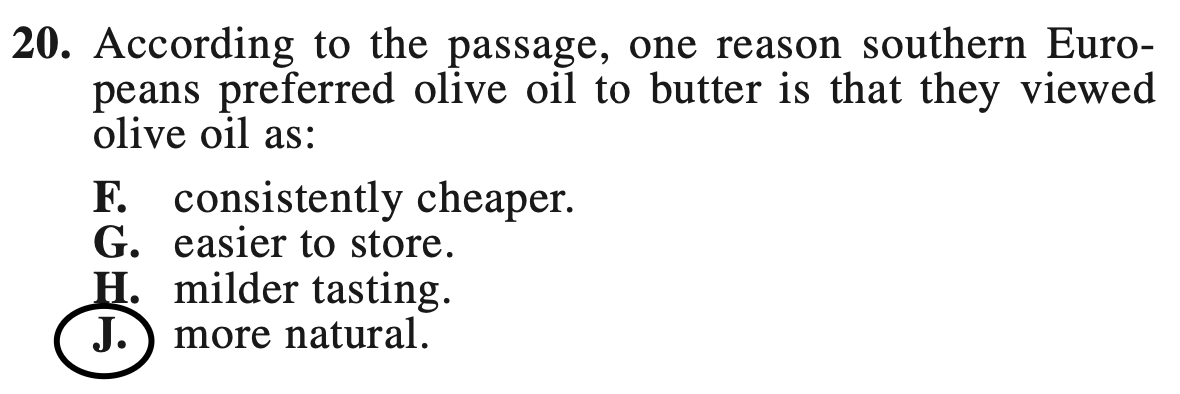
More natural, J, is the correct answer.
Finally, let’s look at our last question from this section, #19.
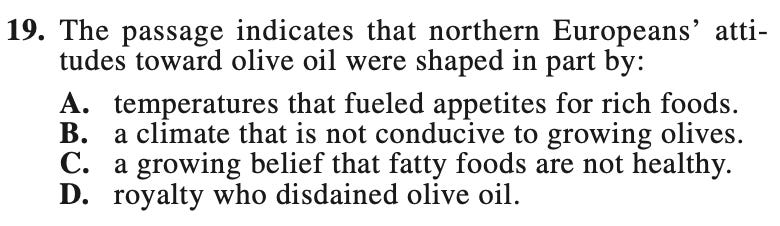
Wait a second. We read about northern Europeans’ attitude toward olive oil already when we were answering the question about Hildegard! Let’s go back to that section:
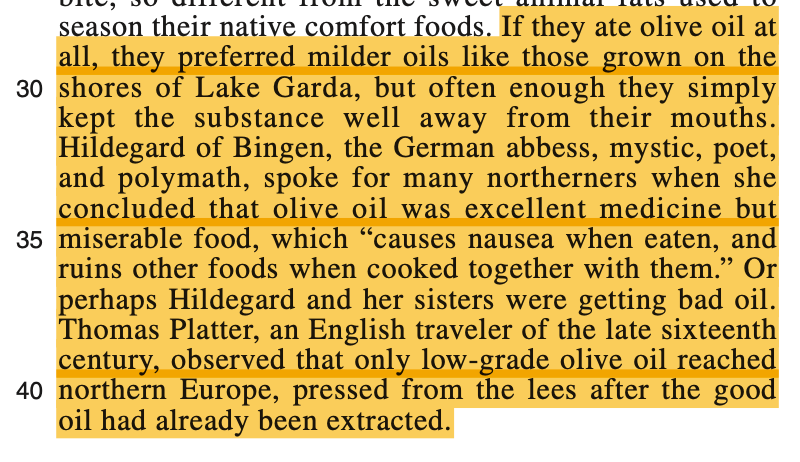
Our friend Thomas Platter explained Hildegard’s view on olive oil (good for medicine, bad for food) was representative of northern Europeans’: “only low-grade olive oil reached northern Europe, pressed from the lees after the good oil had already been extracted.” Northern Europeans didn’t like olive oil because by the time it reached them from the south, it was pretty poor quality. Let’s find our match!
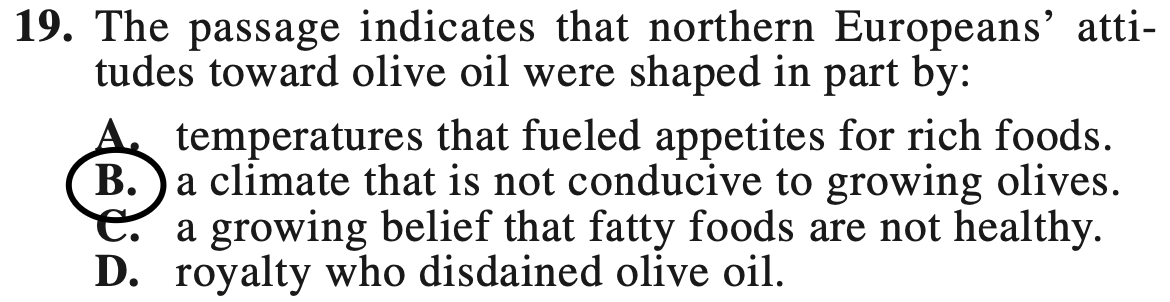
Even though we didn’t exactly see anything about the climate not being “conducive to growing olives,” based on what we have read, B is clearly the best match. If you have some extra time or selecting B without more proof makes you nervous, we can read before these lines to confirm that we’re correct.
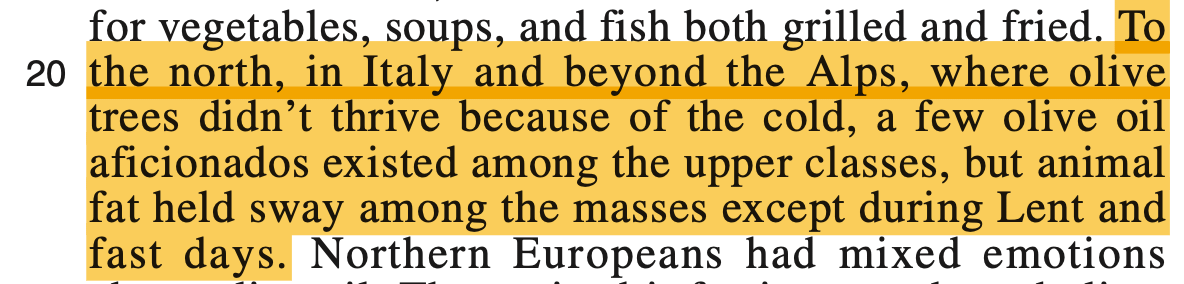
A few sentences before the section we’ve already read confirm that we’re correct: “olive trees didn’t thrive because of the cold.”
Step 4: Answer Questions with Passage-Specific Words and Phrases
At this point, we have only four questions left. We’re going to turn our attention to questions that use other words and phrases we can look up in the passage. We won’t be able to find them as easily as we found our proper nouns, but we’ve read enough of the passage at this point to have a sense of its organization.
Let’s look at Question 18.
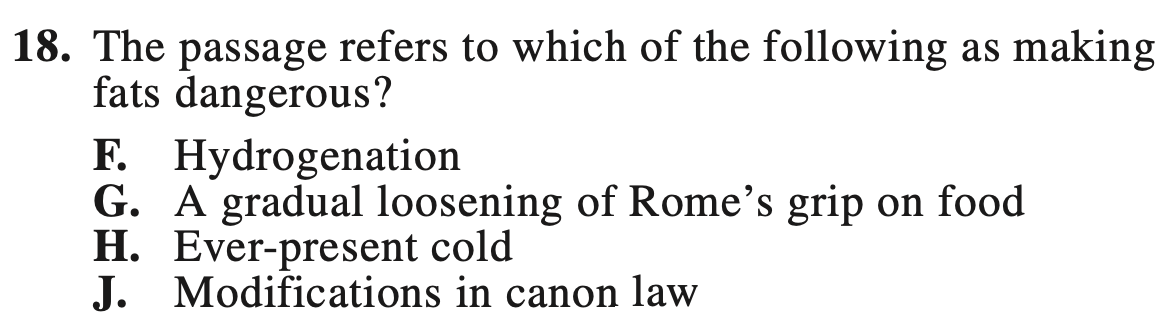
If you’re paying attention, you’ll remember that we learned that southern Europeans thought butter was dangerous. Be careful, though! That’s not what this question is asking about. It’s asking about what makes “fats” dangerous. Furthermore, the southern European stance on butter as dangerous is a view whereas this question is asking about a fact. Let’s try to find something about “fats” and “dangerous” in the passage.
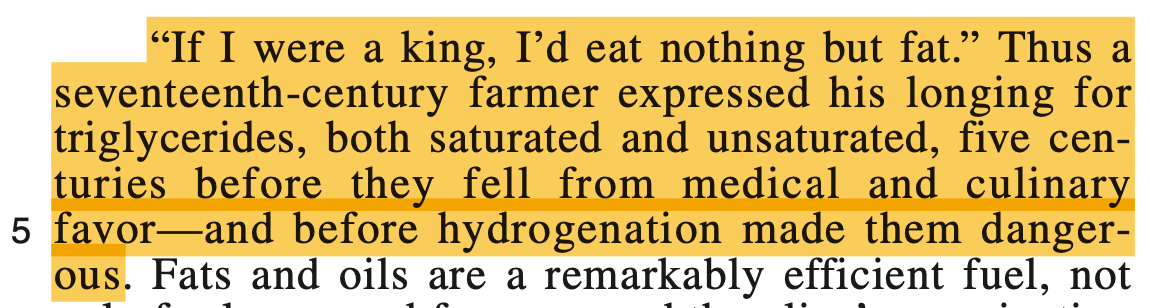
It’s right at the beginning of the passage! Even if you don’t know that triglycerides is a synonym for “fats,” the first sentence clears that up for us. So, what makes fats dangerous? Hydrogenation! We may have no idea what that is, but we absolutely know it’s the correct answer.
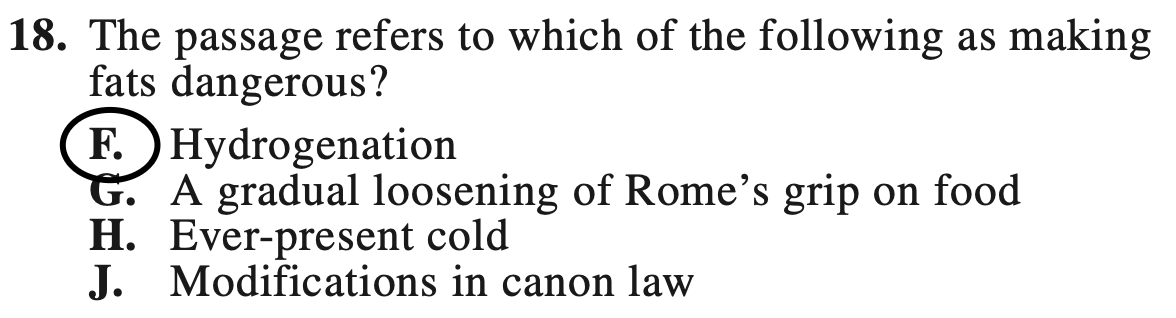
Our answer is clearly F, Hydrogenation.
Now, we can go answer Question 13, which we skipped when doing line number questions, because even though it asked about line 1, it was within the context of the passage as a whole.
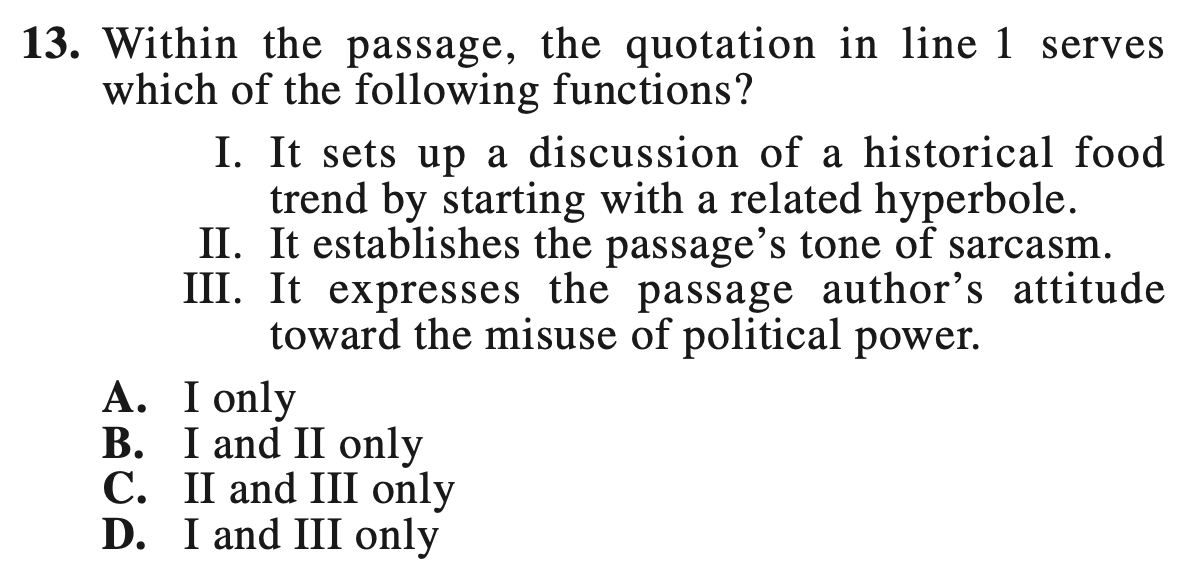
This question is unusual for ACT Reading in that it provides 3 statements and the answer choices are combinations of those statements. First, let’s focus on answering the question, which is essentially asking us to identify the purpose of the quotation that the passage begins with: “If I were a king, I’d eat nothing but fat.”
Ok, so the rest of the passage (at least what we’ve read) is largely about the history of olive oil vs butter, which are both fats. I, “It sets up a discussion of a historical food trend by starting with a related hyperbole,” works, so eliminate C, which doesn’t include I. II says the quotation serves the purpose of establishing “the passage’s tone of sarcasm.” Huh? Sarcasm? Nothing we read was sarcastic in tone, so eliminate B. Let’s look at III, the “author’s attitude toward the misuse of political power”? No, nothing we read even hints at that, so eliminate D.
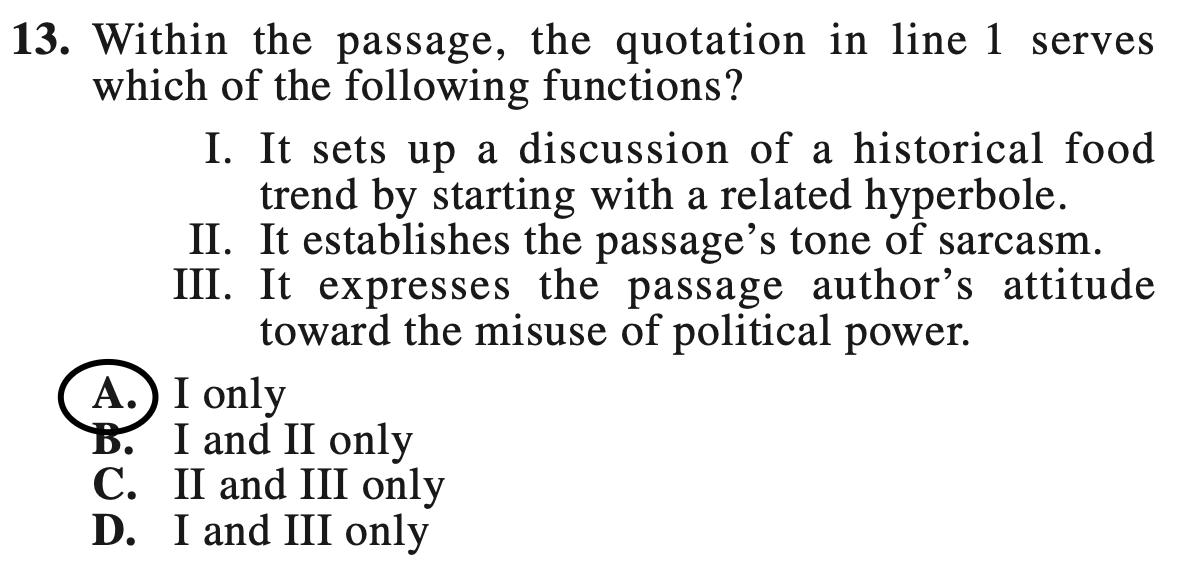
Our answer is A, I only.
Step 5: Answer Remaining Non-Main Idea Questions
When you’ve exhausted line number, proper noun, and phrase questions, go to the remaining questions that aren’t about the main idea or main purpose of the passage.
Let’s look at Question 12:
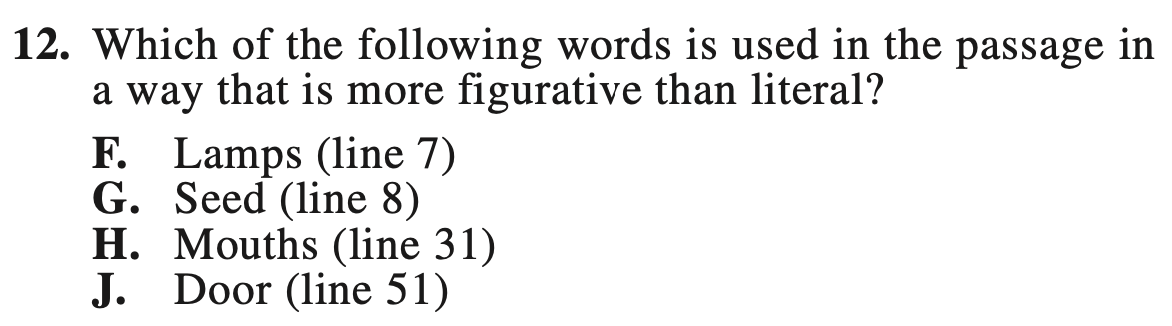
We could have actually also this question in line numbers, even though the question itself doesn’t direct us to where to go in the passage, the answer choices do. We’re being asked which word is being used figuratively (i.e., it’s not the actual word but more of a metaphor for something else). Let’s go through the choices and read the sentence for each one. If the sentence is using the word literally, we can eliminate that choice.
F and G are part of the same sentence:

This sentence mentions lamps (F) using fuel and the seed (G) of the olive. Both used literally, so neither F nor G is correct.
Moving on to H:

Here, they (we don’t need to know who they are/is) are keeping olive oil “well away from their mouths.” This is the part of the passage about Hildegard and northern Europeans, so this makes sense. They were fine to use olive oil as medicine but didn’t love eating it, so it makes sense they would keep it away from their mouths. Eliminate H.
At this point, we can confidently say our answer is J, “Door,” but let’s double check:
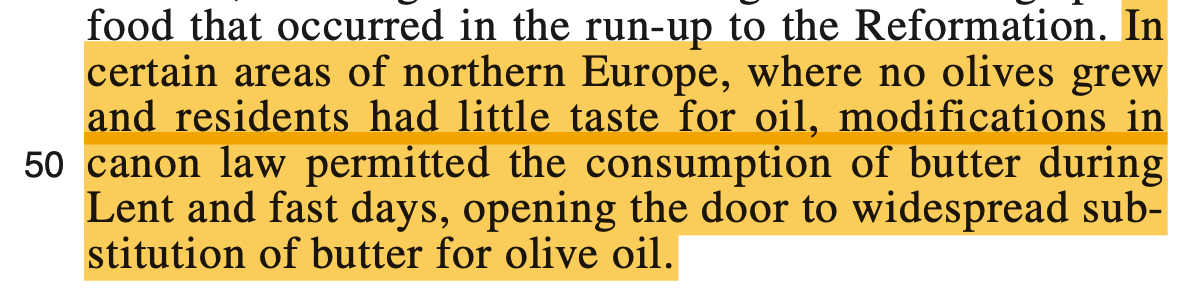
The “widespread substitution of butter for olive oil” didn’t literally walk through that open door; “opening the door” is used metaphorically here, so yes, that’s the word that is used “in a way that is more figurative than literal.”
Step 6: Answer Main Idea Questions
Ironically, the main idea/main purpose question will almost always be the first question of the ten, but it’s best to answer it last. We have a good enough understanding of the passage to say what the main idea is and should be able to answer the question without reading more.
What would you say the main idea of this passage is? The history of olive oil vs butter and specifically how butter became popular when olive oil had originally prevailed as the reigning fat.
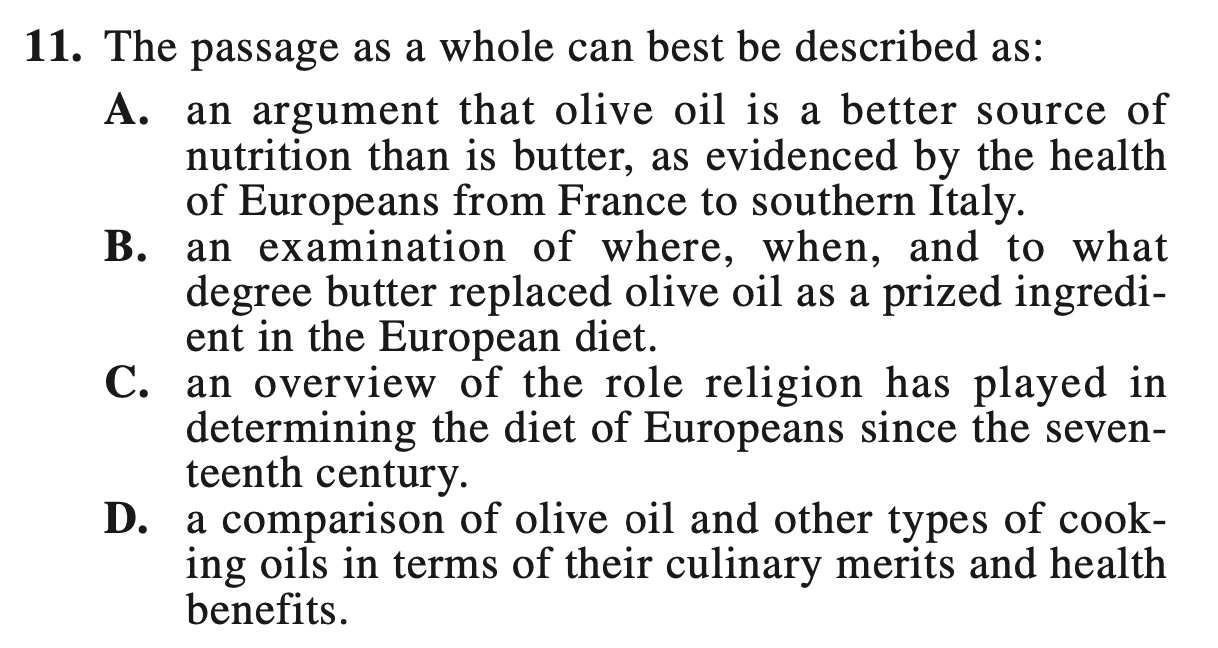
Notice that all four answer choices start with a noun: “an argument,” “an examination,” “an overview,” and “a comparison.” Based on the tone of the passage alone, we can eliminate A. There’s no argument here.
We can also eliminate C because the passage is now about the role of religion. We barely saw anything about religion in what we read.
Note: Answers to Main Idea questions have to incorporate the entire passage. Not just pieces!
While religion may be mentioned somewhere in the passage, we didn’t see it. If you had read the whole passage, you may have fallen into that trap. But given that nothing we read talked heavily about the role of religion, we know that’s not a way to best describe the passage as a whole.
D is tempting. The passage could certainly be seen as “a comparison of olive oil and” butter, but the rest of the answer choice deviates from what’s actually going on. The only other cooking oil mentioned is butter, and there is no real emphasis on “their culinary merits and health benefits.”
Our answer is B, “an examination of where, when, and to what degree butter replaced olive oil as a prized ingredient in the European diet.”
The Takeaway
There you have it! A thorough examination of my preferred strategy for tackling ACT Reading. It might take a bit of time to get the hang of it, but with enough practice, you’ll be flying through the section with time to spare.
In this example, we not only answered all ten questions confidently and correctly, but we also read just 49 of the 87 lines in the passage, a little over half of it! Don’t believe me? Check it out: we focused only on the highlighted portions and still nailed every question.
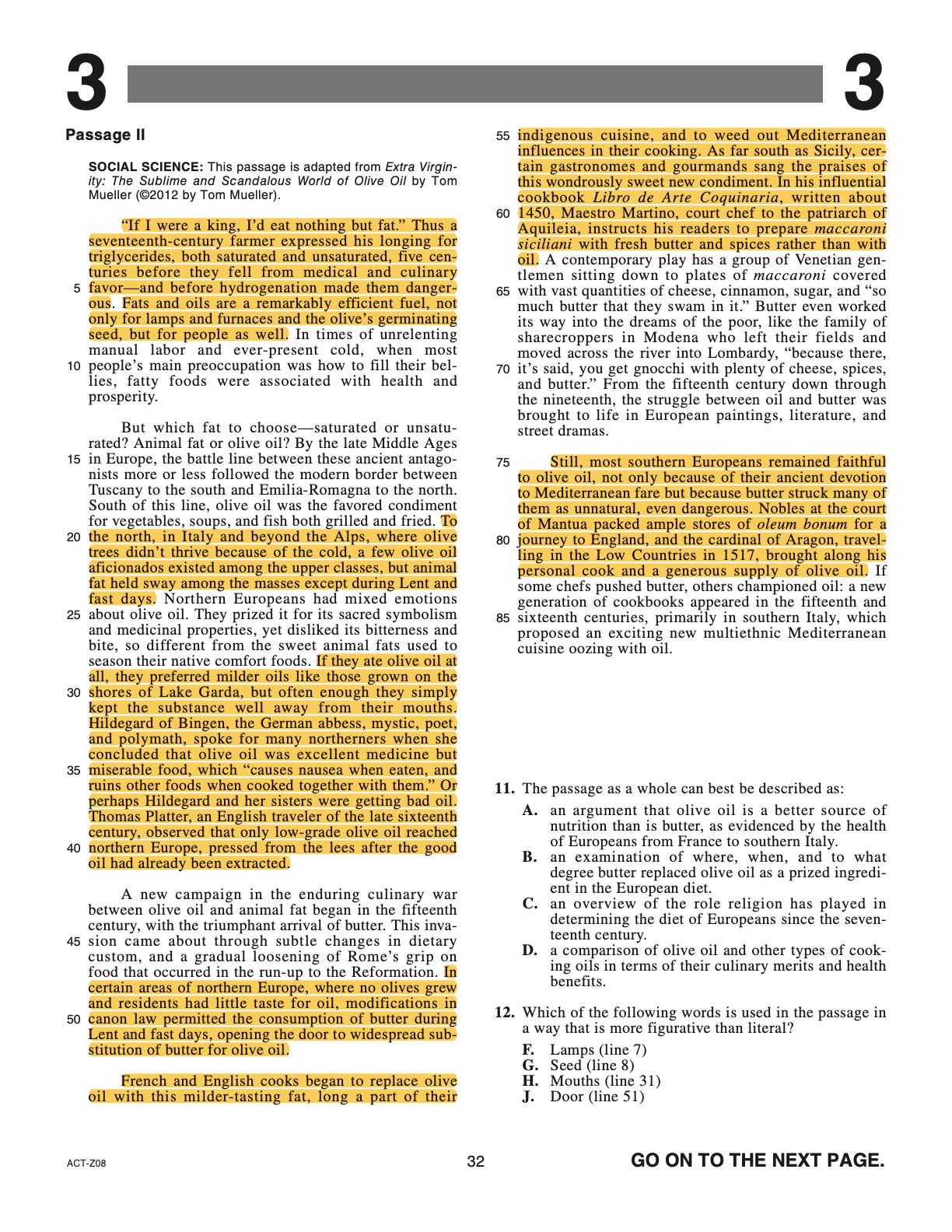
This strategy proves that you don’t need to read the whole passage to succeed on ACT Reading. By prioritizing the right questions and focusing your reading on the most relevant parts, you can save time, reduce overwhelm, and boost your score.
Your Turn
Now it’s your turn! Try this strategy on a full ACT Reading section and let me know how it works for you. Share your experience in the comments or on social media and tag me on Instagram or TikTok, so I can cheer you on or help with any tricky questions.
If this post helped you, subscribe for more ACT and SAT tips, and share it with a friend who’s prepping for the test.
Plus, don’t miss out on my referral program! Here’s how it works:
- Tier 1 Reward: Refer 5 friends and receive a Custom Study Plan tailored to your needs.
- Tier 2 Reward: Refer 10 friends and get a Free 30-Minute Consultation.
- Tier 3 Reward: Refer 25 friends and enjoy a Free 60-Minute Session, perfect for diving deep into your prep.
It’s my way of saying thank you for helping spread the word about Kate Fisher Tutoring. Together, we’ll make standardized tests manageable, and maybe even a little fun!
This piece first appeared on our Substack. Read it there or subscribe to get new essays on testing, admissions, and learning in your inbox.